
The Old King’s Crown is beautiful. It’s a lavishly illustrated craft with peerless style. This charisma reverberates in the game’s excellent writing, with passages leaping from the page in order to set the scene of a King Lear-like situation with a vacant throne. Expectedly, the gears of the work are likewise dashing, powering the entity across a violent journey of conquest and coalition. The Old King’s Crown is a remarkable game.

Designer and artist Pablo Clark’s debut title comes from Eerie Idol Games, a small press troupe out of Scotland. The rulebook credits offer special gratitude to Cole Wehrle and Leder Games, and additional thanks to IV Studios, the periodical Senet, John Clowdus, and many others. There’s a veritable army of supporters that have helped get this game off the ground, and the attributions read like a long family line of successors, soldiers, and allies, all poised to witness a grand tale.
The Wehrle acknowledgement is conspicuous as this game feels unusual in a way that Cole’s designs often do. It bears several unique implementations of existing mechanisms, taking something like the role-based card play of Mission Red Planet and transferring it to a sort of area control, sort of lane battler format that is distinct.
I first saw someone pitch this game as something like a conflict heavy Citadels. That’s wholly inaccurate. It’s perhaps the closest description, but “close” here would only count if we were downing shots and throwing horseshoes.
Take the asymmetric factions, for instance. They start off humble and nearly identical. Divergence occurs through a collection of four mostly once-per-game abilities. These are singular and define much of a group’s identity and playstyle. But your personal deck of cards is what flows in and out of your hand, supporting your claim for aid upon the King’s Road, as well as fighting your battles out in the field and journeying across the empire in search of knowledge and wealth. The cards are the game.
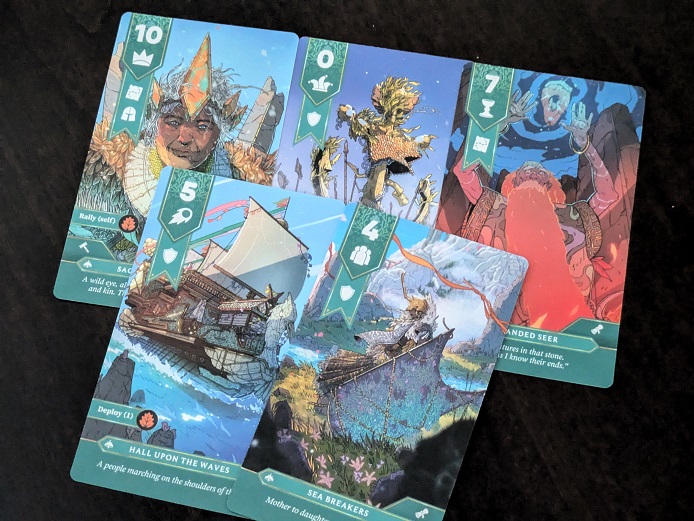
So, it’s odd that each player starts with an identical deck. The artwork is unique and faction-focused, but all of the numbers, icons, and abilities are the same. Unlike Mission: Red Planet you don’t have your entire card set available. Your cards are shuffled and you draw a hand of six. While our card pools are the same, what we have currently available is not.
Hand size is also peculiar. It starts off at six for each player. As soon as you must shuffle your discard in order to draw a new card, you suffer attrition. This results in your hand size dropping by one permanently – it’s tracked on a nifty dial near your player board. It’s a brutal penalty, one which deserves some caution. A smattering of abilities and effects influence hand size, such as returning cards to your deck or allowing you to outright ignore attrition one time, and it’s clearly a core component the game wants you to contend with. As stated earlier, the cards are the game, so maintaining a strong hand is of utmost priority.
Cards are used in one of four ways. The first is a blind simultaneous bid, where only the strength at the top of the card matters. In descending order, players select one of four Kingdom cards along the King’s Road. This is functionally an open market that rotates new options in from a large deck. These cards are powerful. They tend to be passive abilities or new actions you can take during certain phases of the game.
The second and most prominent use of player cards are for combat. This is where the game scoots an inch towards both Citadels and lane battler territory. Players simultaneously select a card from their hand and place them face-down adjacent to one of three areas on the main board. These cards are supplemented by supporter pieces that function as troops, although they’re less plentiful than is typical in this style of game.
Battles are wild. They are resolved one at a time, with the order being determined by the player currently in last place. Timing is extremely important. As a battle is resolved its victor is primarily determined by whoever plays the highest value card. Those supporter pieces add to this total, but usually there are only a few in any given battle, and many battles will have none. In addition to cards contributing the majority of strength, they also may have special abilities. These are all interesting selections that add a great deal of texture to the conflict. You can flank to a future battle, effectively doubling your card potential in that upcoming struggle at the cost of abandoning the current one. You might be able to retreat a card to your hand or deploy a new one spontaneously. One card in each player’s deck is an assassin, and they can even kill every opponent’s card in the conflict. As I said, absolutely wild.
The objective here is to win the conflict so that you may claim one of two rewards where the battle occurred. This is typically a single victory point, as well as a mechanical effect such as winning the Kingdom’s Favor token which allows you to trigger a faction ability or manipulating your hand and discard pile to delay attrition. One highly sought after location awards two points, which is considerable.
But this is a weird game. The real way to acquire substantial pointage is to win where your herald is placed. Each player has this funky meeple that represents a primary actor in their faction – perhaps a leader, or bannerman. You take turns placing your herald in one of six spaces. Each main region where a battle occurs contains two sub-locations. If you win a battle in the region where your herald is, and if you claim the sub-location reward, then you score an additional point. More importantly, you steal a point from each other player whose herald is also on this space. This is a significant way to increase or shorten a point delta, and it’s one of the most potent tools in turning the game on its head.

The final two uses of cards occur later in the round, in the post-battle Autumn phase. Here, you can use a card from your hand to journey. This allows you to acquire lore, the only resource in the game, which is spent to add new faction-specific cards to your deck. These additions are powerful, often containing higher strength than anything in the standard deck, and also usually paired with a powerful ability. Some of these cards are locations which are placed in your play area and offer a new action or permanent effect. Just like everything else in this game, these sometimes feel unhinged, tearing open new tactical options and raising your power level to a new rung. This slow drip of asymmetry is ultimately satisfying as the payout is commensurate with the delay. You also can’t typically obtain all of these cards in a session, which leaves a desire to test new vectors in future plays.
The final use is placing a card in the court. This is an area at the top of the board where cards contribute to special actions. One such action allows you to spend the cards in the court as bonus victory points if you win a battle where your herald is present. Another allows you to place tokens on a location that build up over time, eventually triggering the effect on the space. This is a neat way to attain the special battle rewards, even if you’re unable to triumph in conflict. The third section of the court is how you retrieve spent supporters, effectively rebuilding your troop pieces.
All of this is supremely tricky. The Old King’s Crown is a liberal game, one which allows you to yank many levers and approach it in a multitude of ways. It’s a heady and cerebral game. But it’s also thorny and devoid of guardrails. You can misplay a battle and lose a cherished card. If an assassin slaughters your eight-strength knight, it’s just killed. It’s out of the game for the same amount of time as the beast needs to be locked up. FOR-EV-VER. Likewise, your supporters that contribute to strength in battle are never returned if you don’t leverage the court to get them back. What if you’re not keeping an eye on your deck and realize you suffer attrition at a very inopportune time? Well, then your whole next turn will be thrown off, as you likely won’t have enough cards in your hand to participate in every phase of the game. This can snowball.
There is a tremendous amount of tension in managing your deck and hand. Deciding whether to utilize a high strength card in a bid for a Kingdom card, versus holding it back for the battle, or possibly journeying later in the round – it’s all difficult and thought provoking. As soon as you’ve suffered attrition you won’t be able to participate in every phase. You may need to forego the King’s Road or ignore the court altogether. All of this has downsides and giving any ground is rough. Yet, this feeds into the game’s rich strategic musculature.
Everything feels precious, fragile even. Control is fleeting and the game has a will about it. This quality very much reminds me of the Wehrle design philosophy.

A portion of the hobby will outright resent this game. Battles are difficult to predict. In fact, the chaos is charming and certainly dramatic, but it can be overwhelming at four players. It will often appear that there is simply no safe or secure play, and you’re making moves hoping that an assassin is not in the battle or that your opponent is playing their 10-strength leader elsewhere. Counting cards is rewarded, and likely necessary for high level play, but it can require a great deal of experience and wherewithal. With four participants, everything is more unstable, and outcomes are incalculable, making it all more difficult.
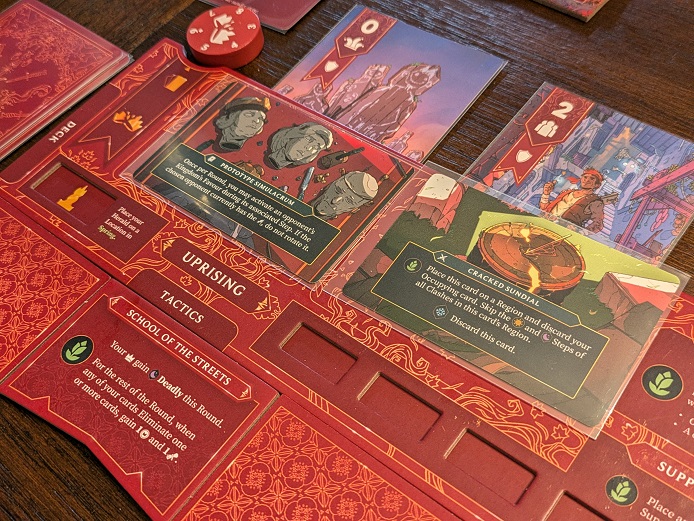
In one game I was playing as The Uprising. On the surface, this faction spoke to me. They’re a little Jinteki-ish, relying on traps and trickery to torment opponents. In a key moment, I used my once-per-game tactic to swap player’s facedown battle cards before resolution. I carefully examined the board state, reflected on my in-game knowledge, and read my opponent’s intentions. This led me to swapping cards with the purpose of weakening them in the area I was vying for with my herald. Through what felt like sheer random nonsense, I swapped in a stronger card my primary opponent had played elsewhere. There is certainly an element of bluffing in this game – which can manifest in delightful ways – but that’s not what happened. I was just burned by quantum absurdity.
Another session saw me go all in on an area. I carefully evaluated each of my foes and deliberated before making the move. I was aware of which cards had been played in previous rounds and what was unavailable. Unfortunately, I missed an ability an opponent possessed in their sprawled tableau. They let ‘er rip and narrowly won the battle, casting all of my supporters to the lost pile and flipping a large amount of points due to placed heralds. I also suffered attrition after this, which wouldn’t have happened if I won the conflict. Oof. Massive oof. This was avoidable of course and would absolutely be less likely with more experienced play. But it’s still something inexperienced players are prone to suffer.
The Old King’s Crown is a merciless game. I’d call it callous. There are catch-up mechanisms, such as deciding the battle order and taking certain actions after others, but you can find yourself down a well in a hurry.
This is why I prefer it as a three-player endeavor, as the game state is more exposed. Probability is more evident as there are less cards and abilities to monitor. It’s all more reasonable. Particularly for a game that can go three hours with a full table.
Regardless of player count, there is one aspect that has kept The Old King’s Crown from usurping some of my favorite designs in this space. The battles lack dynamic compositions in a way that is completely foreign to the genre.
In most area control conflict-heavy affairs, a mix of battle situations occur. Often, you will be able to conquer or initiate conflicts with overwhelming superiority, or at least from a position of knowledge. If you pour enough resources into a struggle and focus on a lesser area of contention, you can sustain a high probability of success. I’m talking about the lulls in these types of games. where you push a weakly defended border or you pile all of your troops into a lesser armed point. Maybe you simply take over an empty area. This creates a dynamic tempo where conflict ebbs and flows. The stakes vacillate between high and low and there is a sense of contrast between clashes.
Not so in The Old King’s Crown. Every single battle has every single player involved. Because cards are the primary source of strength, anyone can pull out an unexpected win. It would be like if Blood Rage was just battles and every battle had few or no figures participating. Or if Dune was 15 fights in a row where potentiality required disciplined game state tracking. It can seem as if agency is quite limited at times.
From a certain perspective, this is awe-inspiring. It’s dramatic, which I strongly attach to in games. But it can also be too much, particularly if you tend to take the whole thing very seriously. While this quality exists regardless of player count, it is more conspicuous at the max number. With fewer players, the experience transforms from a goofy lesser Cosmic Encounter-like circus into something that’s more cunning, deceptive, and adaptable. I wouldn’t shun the game at four, but my enjoyment noticeably drops.

While my criticism stands, the upside of the battle system is that it is indeed always dramatic. Always. Almost anything can happen. Conflict is a burst of hellfire with shrapnel flying in all directions. Sometimes you’re left whole, other times chunks of flesh have been carved away.
When your plans are well reasoned, when you read your opponent’s deck composition and card placement skillfully, it feels monolithic. Some games shun the big plays, afraid to allow for explosive outcomes. Not here. This thing is all about enormous all or nothing gambits.
One final thing I want to detail concerns the unexpected effectiveness of the solitaire mode. It is robust and intricate, without being overly complex. This design employs a clever framework that utilizes randomized hidden maneuvers to mimic an opposing player. It participates in every nook of the system, including the court, battles, and bidding for Kingdom Cards. There is a neat mechanism where priority is determined based on what the simulacrum is aiming to do, and it dictates behavior in a surprisingly smooth way. Most importantly, all of these details come together in a very lithe and executable system that is a pleasure to fiddle with. I won’t personally view this game as a primarily solitaire pursuit, but I could imagine someone gleaning a decent lifespan from this addition.
In all facets, The Old King’s Crown embraces excitement. This is where my esteem resides. The corners aren’t rounded. The spirit isn’t flattened. This is the type of work that keeps you at attention, constantly plotting in an effort to wrestle command from the game itself. Yes, it can be distressing, but it also is exhilarating and effectual. While some may rebuke this creation, others will embrace it with infatuation. I’m far more in that latter camp.
A copy of the game was provided by the publisher for review.
If you enjoy what I’m doing and want to support my work, please consider dropping off a tip at my Ko-Fi or supporting me on Patreon. No revenue is collected from this site, and I refuse to serve advertisements.
 Player Elimination
Nice, Transformers: The Movie reference.
Excellent write up, I can say nothing more on this front, other than, I tip my hat to you, good sir!
I agree with your criticism regarding player counts, though in my experience with this game at all player counts I found both enjoyment and frustration, but the sweet spot is most definitely 3 Player, but if someone else wanted to sit down and make it 4, I would never say “no”.
Terrors End
LikeLiked by 1 person
Thank you. Gotta rep Starscream.
LikeLike