
Barbarian Kingdoms is the kind of modest board game that comes in a standard sized box with a small selection of cards, a reasonable number of tokens, and a surprising absence of miniatures. While it is nearly two years old at this point, it actually appears more long in the tooth and weathered. I wouldn’t call it dated, but it certainly eschews modern trends as it seeks reduction not excess. This is rare in the thematic genre of area control, especially when the simplicity is not masked with heavy content or over-the-top components. In truth, Barbarian Kingdoms is like a side-dish of meat and potatoes.
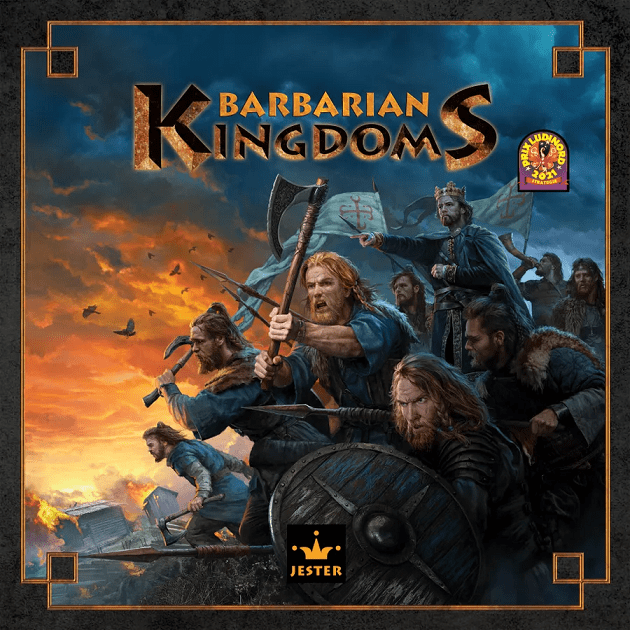
It presents as a thematic area control game that cuts out much of the faff and gets right to the good stuff. One of Barbarian Kingdoms’ potent tools is its pace. Each turn has players performing a single action. They are all simple and direct such as taxing your conquered people for wealth or invading a single neighboring province. Most turns are measured in seconds, and play continues around relentlessly. In this way, the system works admirably well at larger player counts. It hits the stated box length of an hour or so and offers a tense state of conflict.
Facilitating this reasonable playtime are the transparent victory conditions. Instead of the staid format of points, players are racing to either conquer seven total areas – they begin with three – or kill two opposing kings. As soon as you accomplish one of these goals you immediately win. This is right in your face and easy to identify with the clarity of board state. It also harnesses the Twilight Imperium flourish of needing to maintain control of your starting area to even qualify for victory. This allows for counterplay and hubris to sink an otherwise flawless vessel.
The second aspect deserving a toast is the way in which it handles resources. Like the world we’ve built, it all boils down to money. Gold is earned through invading neighboring provinces and pillaging them, or by taxing your own regions. In a near brilliant stroke, the entire economy is a closed loop. When you recruit a new unit, you place the coins you spend in the area the troop is deployed. If you gain control of a new region, the gold cost to do so is placed that region. You can then later tax these funds and pull them back behind your player screen.
This is fantastic and the standout design detail. There’s a nice interplay between economics and action economy, as you have to determine where you want to spend the money and how it will be distributed in your areas. Spend too much in a specific kingdom and you may bait an opponent into attacking it so they can scoop up those funds. It’s interesting watching players navigate these considerations and internalize the nuances of the system.
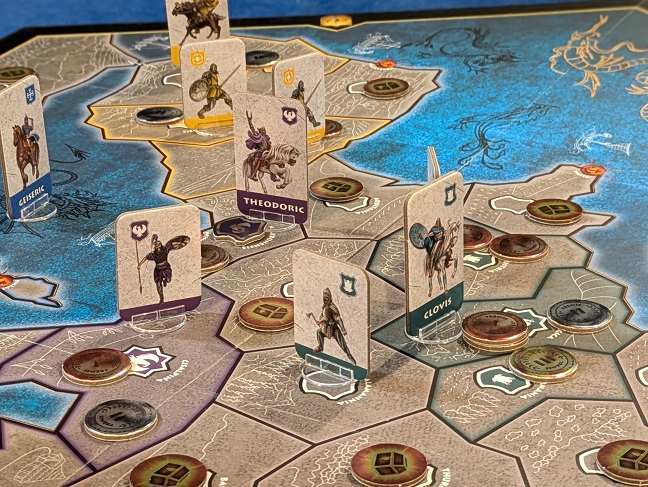
The economic framework serves as the foundation for combat. In a kind of odd borrowing of Blood Rage’s conflict system, players can respond to you invading a region. The first to affirm can then move units into the area and contest your aggression. This is a back and forth, with active player and respondent shuffling units in and deciding on how big to go.
But you need to follow the money. The good part is a blind bid where players spend from their hidden treasury to boost their combat value. Typically, this is a more significant source of strength than the units themselves. There’s a wide degree of latitude in strategy and bravery, as large bids rock the table and can upend the economy.
The loser just outright dies, again like Blood Rage, with all of their units crushed and broken. The consolation is that the money bid for combat strength is given to your opponent. This is such a brilliant decision that fuels so much interesting play and drama. For instance, I’ve responded to opposing players by challenging them with a single unit just to tease out money. Sacrificing soldiers in this way is very effective if your foe has their king on the line, as they’re more likely to bid a nice chunk of coin in order to minimize risk. In a recent play, after establishing this as a reliable move in my group’s meta, I pushed a single footman into conflict with an opposing king and unexpectedly bid all 14 of my gold. Boom. The king is dead. My opponent’s jaw was dragging. It was exhilarating and reminded me of some of the highs of the Dune battle system, which I hold as the strongest in this class.
The dual wielding of interesting goals and a fired-up economy is enough to firm up Barbarian Kingdom’s position as a worthy hour-long campaign, but there are a few qualities which cause restraint. One of my criticisms is that it lacks texture and grit beyond those two core tenets. In fact, much of it is flattened and featureless in order to serve its playtime and minimize friction.
The map is a solid example of this. It’s a geographical representation of Europe, depicting the game’s historical period of barbarian tribes ravaging the Roman empire as it waned. The regions and layout are fixed. Each kingdom’s starting position is also set in stone, and there’s no variability here. Both of these have an enormous effect on the feel of play. With repeated sessions patterns emerge. Due to geographic orientation, factions have a limited set of openings. Certain kingdoms have precious few options, and basically one approach. This leads to an early game state that is repetitive and expected, which undercuts the game’s strengths. Part of this is the limited action menu and streamlined play, but choosing to invade first and tax second doesn’t feel terribly different than taxing first, recruiting a unit, and then invading. While the battle system is highly dramatic, the moment-to-moment activity is not.
This quality of semi-scripted behavior and an associated level of tentativeness extends too far into the arc of play. Participants are often reluctant to engage in significant battles and risk taking as they would leave themselves vulnerable elsewhere. Instead, there is a plethora of low hanging fruit in terms of neutral areas you can mosey into. You get the same sequence of play as seen in larger games like the aforementioned Twilight Imperium, where players slowly spread out and make steady progress on the victory conditions without placing their head close to the chopping block. Too often, the good stuff doesn’t happen until the final 20-minutes or so. The primary problem is that the buildup is blander than its bigger brethren, mostly due to an absence of faction or kingdom development.
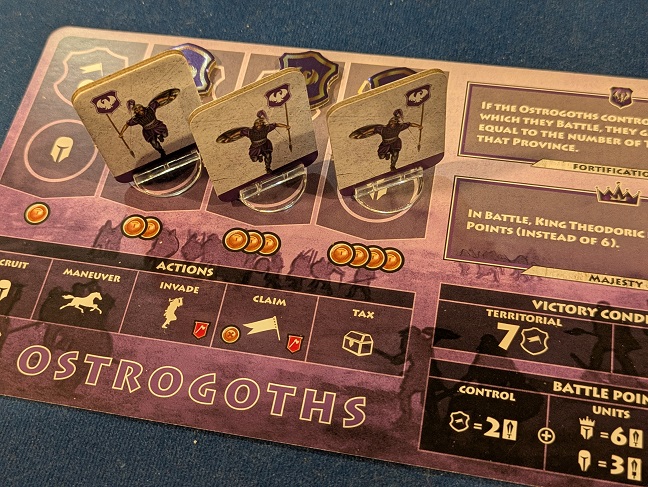
I’m not sure the solution here. With fuller games like Ankh or Eclipse or Cyclades, there’s an interesting early and mid-game where you attain new powers and assets, or you make key decisions on how to shape your empire in preparation for the coming onslaught. Barbarian Kingdoms seeks brevity, so cuts much of this out. Instead, much of the first two acts are waiting for an opponent to make their move and signal the finale.
One surprising facet is that this complaint is minimized to a degree by eliminating players. That is to say, Barbarian Kingdoms hits harder at three-players than it does at six. The game has this natural Chess-like edge to it, where potential maneuvers are clear and agency is narrow and direct. There’s little randomness here, no deck of events or special powers, no big swings beyond the bids in combat. At a lower player count, there seems to be more room for deviousness and layered tactics. You have less exposed frontier, and you can somewhat accurately track the total wealth each player possesses. At larger counts, potentially risking a large sum of money and one of your few units is enormously punished. If things go South another player can expand their border uncontested by chipping away at your unprotected holdings. So, the game feels like this set of mousetraps that are all primed and ready to snap. At three-players, you exactly know where you’re vulnerable and can work to put up guardrails or manipulate your opponents in various ways. In this format, it feels as though the strengths of the design are more strongly attuned.
Particularly at the larger player range, Barbarian Kingdoms would benefit from a source of hidden information beyond gold. A set of cards similar to Dune’s treachery deck would greatly open things up and afford more dynamic plays and risk taking to avoid that budding stalemate. That of course would add weight and density to the design, something author Christophe Lebrun would likely flinch at.
But there’s a central lack of spice that holds it back just enough to alter my impression. It leaves me wondering more about potential than actual. Despite this, it is a charming experience that strikes in a similar fashion to Tiny Epic Kingdoms, albeit with more heft. We don’t have a bounty of strategy games that support up to six players and wrap up in an hour or so, and as you can clearly see, I’ve enjoyed Barbarian Kingdoms enough to play it repeatedly and with interest. I just wish it was a little more, without its highest peaks relegated to a couple of battles spread across the final 20-minutes.
A copy of the game was provided by the publisher for review.
If you enjoy what I’m doing and want to support my work, please consider dropping off a tip at my Ko-Fi or supporting me on Patreon. No revenue is collected from this site, and I refuse to serve advertisements.


Huh, hadn’t heard of this one. I’m always looking for games that play well at 6 in under 2 hours, and this one looks fairly interesting. But like you mentioned, I feel like I’d want A BIT more meat on the bone. This seems like it would benefit from removing the historical setting to have a more balanced map, and add in another mechanism or two. Cyclades still holds the top spot for 6 player area control games for me!
LikeLiked by 1 person
Yes, agree on Cyclades rocking at 6. Such a grand game.
LikeLike
I think this game is the definition of a “hidden gem”, so easy to play, hard to masters, rules that have been cut to the bone, not an ounce of fat but it is far from a bland game, every king has a specific power, every nation has a different strategy, you have as much fun at 6 as at 3 and no game lasts longer than 2 hours (6 players games clock at 1h30 with my fellow players that are quite slow).
This is my go to game when I want to play something that has simple but not simplistic rules, a specific flavor, won’t overstay its welcome and everybody around the table will have a smile on his face and remember the time he bluffed and overthought his opponent.
I usually agree with your reviews but think that you really missed the brilliance of this game.
I think every serious gamer should get this one, it’s too bad it didn’t get the recognition it desserved (when you see how many less interesting and less well developped games get the hype).
LikeLiked by 1 person
I totally understand and respect your opinion. I think my review was relatively positive, although I did point out criticisms and didn’t laud it with heaps of praise..
I have to admit, I would be stunned if anyone would find they agree with me strongly across all of my reviews. It’s just the nature of how subjective this stuff is. I don’t think my opinion is more accurate than anyone else’s.
I’m glad you enjoy Barbarian Kingdoms, Sam. Christophe seems like a good person and I believe he is planning on doing more with the game/system in the future.
LikeLike
Thank you for your answer an thank you for your reviews, as you say, it’s impossible (or suspect) to agree on everything but your insightful reviews are always a pleasure to read.
LikeLiked by 1 person