
You’re stumbling through the labyrinthine streets of Old Angeles; your clothes soaked in rain and neon. The city is a mix of perpetual darkness and the unending belch of industrialization. But at least you’re not alone. Your private investigation firm is staffed by the other stiffs sitting around the table. All of you are working in unison to bring back the girl. Yeah, that one. She went missing a couple of days ago and your sorry crew caught the job. If you want to do right by the girl’s family – and more importantly, if you want to eat – you better get moving.
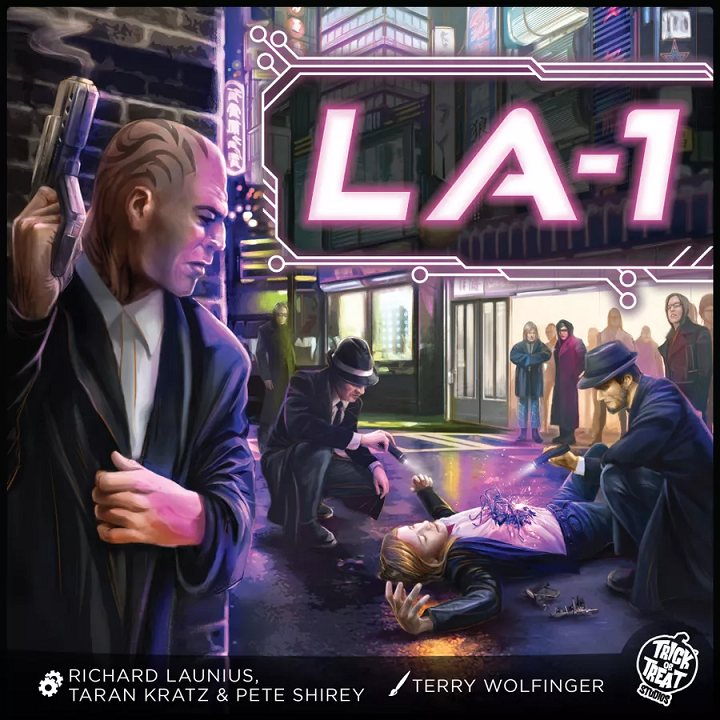
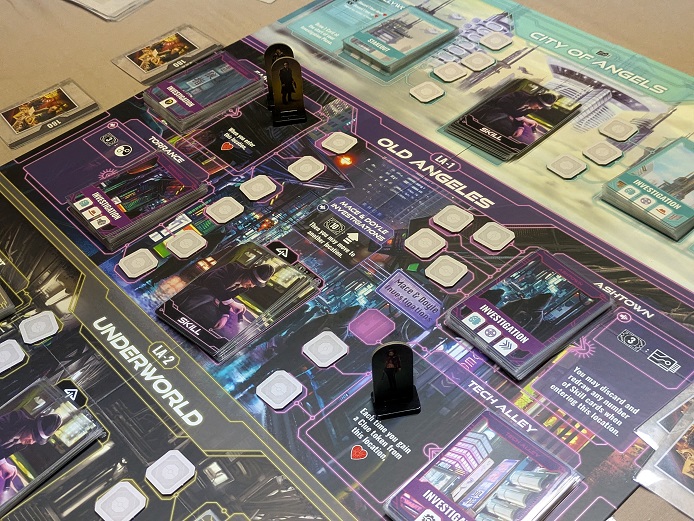
The mood of LA-1 is cracking. It’s established by a large sprawling board of three-tiered future Los Angeles, excellent narrative vignettes, and intriguing scenario writing. This game sells you hard on its premise and it knows right where to jolt you. All of this is followed through with sharply integrated gameplay.
It’s easy to attribute the design primarily to Richard Launius. That’s because it shares some core qualities with his most famous work, Arkham Horror 2nd Edition. But one must not neglect the other members of the trio, which includes Taran Kratz and Pete Shirey. Kratz established himself with the Helionox series of games while Shirey helmed Delve and Shark Island. Both have years of industry experience and contributed heavily to the design of LA-1.
Yet there’s a reason why this is necessarily compared to the classic Fantasy Flight Games’ edition of Arkham Horror. The structure is nearly identical.
Players alternate turns moving around the city and triggering encounters from location specific decks. These event sequences are the heart of the game, offering narrative decision points, attribute-based skill tests, and a pileup of unforeseen consequences. Another player draws the top card and reads you the scene, offering the story-based decision points that lead down all manner of alleyways. These encounters form nearly the entirety of atmosphere and personality, and everything else is bolted atop this rugged engine.
Characters are asymmetrical and grow in potency over the course of play. Secondary missions and ulterior considerations arise organically. Foes deal lasting physical harm to the protagonists, but the real threat is the darkness track, which abstractly represents the background forces working against the group. It’s a time pressure element that feels generous at first but can quickly swallow up the investigation and provide a tragic ending.
All of these things are classic Arkham.
Where LA-1 gets interesting is where it diverges from its ancestor.
First, let’s talk about the resolution system. The dice are tossed in favor of a card-based mechanism utilizing a shared fate deck, a la Gloomhaven. Players can nudge the odds in their favor by playing skill cards from their hand which match the nature of the test, but they must commit to this play before revealing the fate deck’s result. Committed skill cards are added to the fate card and checked against a target number to determine success.
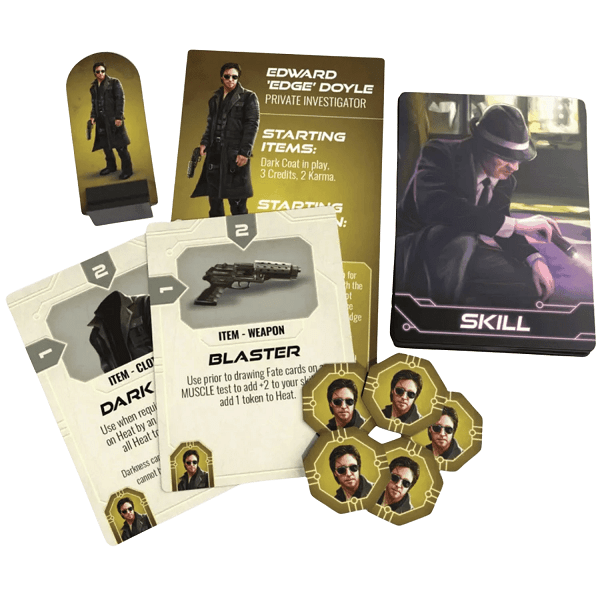
It’s difficult to really say whether this is better than Arkham Horror’s five or six equals success on a pool of six-siders. The dice resolution’s main pro is that it’s faster, which is appreciated in an adventure game where the emergent narrative bits are the star. But it’d be unfair to knock LA-1’s clever card play. Character asymmetry is tightly expressed in the personal skill decks. Gaining cards in a deckbuilding-like fashion is much easier to manage and internalize than the various skill tracks and item cards in Arkham. There’s little need to reference anything, and the complexity is encapsulated with ease. There’s a sense of unity here that just doesn’t exist with tacked on extra cards and abilities through various means. You also get cool details with LA-1’s card play like exploding tests, multi-use items, and even amusing diversions like a side job of delivering passengers across the city as a taxi driver. All of this is delivered via the asymmetric starting character decks as well as new skill cards gained during play.
An interesting quality of this method is the necessary cooperation, both within the fiction and within the meta discussion. Those sharing a location with the active player may help by contributing a card from their hand to the test. This encourages strategic planning that intersects nicely with the back of location cards offering a small subset of possible skills that the card may trigger. This offers an idea of what may be encountered, and it provides soft guidance for capable peers to act as backup for investigations. The group also has the option to reshuffle the fate deck prior to any test, which naturally engenders discussion about what cards have already flipped and trying to gauge the probability of the oncoming test.
Beyond table talk, it conjoins players within the narrative and encourages improvisational story framing. Occasionally a specific action sequence will be described, and it will intersect with an item carried or a skill card slammed down. These neat connections help push the narrative to the fore and prevent it from falling behind a wall of mechanistic fog.
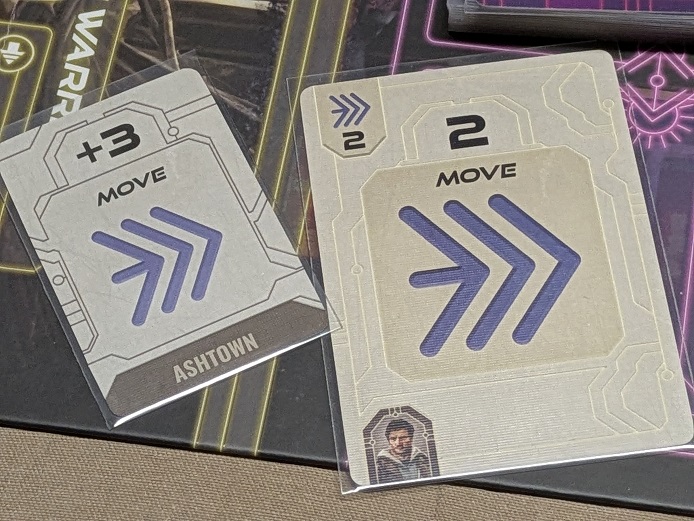
A fundamental aspect of all of this is how it evokes character. Yes, it manifests your identity through the quantities and values of the various skills – if you’re beefy, you’re going to have high muscle cards in your deck – but also through other vectors like those jobs and items. When you draw an item card into your hand, it’s a wonderful little jolt of energy as you can freely put that stun stick or hovercycle into play on your turn without eating an action. These items are then used a couple of times before retiring to your discard pile where they will cycle back through into your draw deck and re-appear later in the game. There’s a constant motion of expressed character identity forming and coming into view, then fading and subsequently reconstituting around new abilities and items. It’s akin to the buzz of a current changing modulation as various aspects of machinery come to life and then power down. This momentum of identity is a strong feature of the card system and an easy thing to overlook when examining this game. Amusingly, it draws parallels to systems like Android: Netrunner and Arkham Horror: The Card Game where your deck is a multi-faceted character build. But it does so without pre-game preparation, and instead through initial asymmetry and a well-developed growth arc. Of course, it’s more subtle than those card games as I wouldn’t call the couple of items or abilities in play a true tableau, but it stirs a nascent notion of tooling up.
One underrated element is that it gives you an area of agency. Really, it gives you something else to do. The bulk of play is running through those narrative encounters, which ultimately is done in the hopes of gaining facedown tokens placed at each location. Some of these tokens are clues, which are spent in various ways to progress the scenario. But these narrative encounters happen automatically during the investigation phase. All you need to do is be at a location and you will have the option to resolve the topmost card. So, what do you spend your actions on?
A lot of the time you will be travelling. Certain locations allow you to perform special actions, like gaining money, drawing cards, or spending your dough to gain a new skill card. There’s a lot of fiddling around in the margins in order to setup your character with the highest probability of success. All of this endeavoring is quite fun, as rewards tend to be rapid and there are not a lot of hoops to jump through. And as I said, the story just hits you in the face like a train barreling down the track. The point is that this loop is pleasant. You’re not rushing around putting out fires and trying to contain horrific threats as in its progenitor. Everything you do is proactive to improve your character or your group’s position relative to the scenario.
Let’s talk about the scenarios.
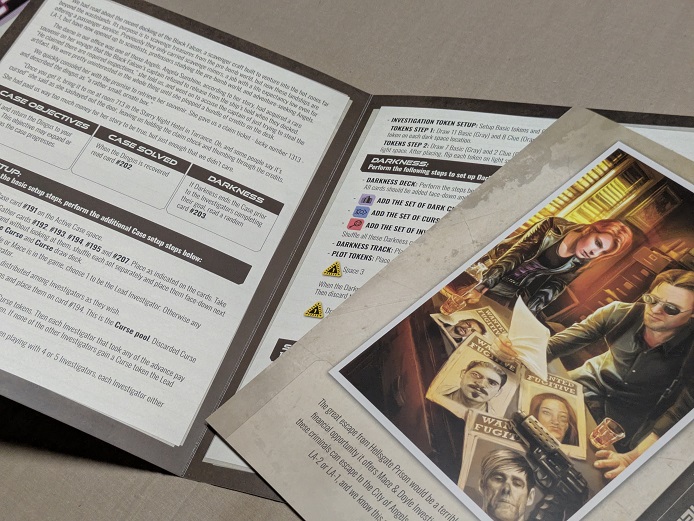
One of the most noteworthy elements of LA-1 is its implementation of scenarios. They’re essentially jobs performed by your detective agency. Think classic noir Bogart stuff like hunting criminals, finding the missing, or tracking down vital information. Each scenario is a bespoke module of components with its own set of cards and a cardstock leaflet. There is an introductory narrative, setup instructions, and any necessary special rules. What’s intriguing is how they twist the standard framework.
There’s a lot of creativity on display. Cards are utilized to represent a number of things, often attached to portions of the board to represent people or places you can investigate. They may introduce specific homesteads or properties that function as sub-locations you can visit. Sometimes they represent vague leads or contacts. Often, surprises and twists are thrown your way. It’s all cinematic and editorialized with stylish writing. Again, the inventiveness in card usage reminds me of Arkham Horror: The Card Game. And again, this is not nearly as robust as the scenarios in that LCG, but there are tendrils of similarity in terms of how the designers wield components in very interesting ways.
Here’s where things get a little more nuanced. The box only includes four scenarios. As I’ve said, these are meaty things that will take you 2-3 hours to complete. They sit atop the existing game engine, utilizing the generic clue system to progress specific story beats. It all flows relatively well and with efficiency. But the burning question is whether this is enough content. This is highly subjective, but the answer I’m most comfortable with is that it’s a sturdy amount yet not quite generous.
The key point here is that these scenarios are replayable. Intentionally so. They’re more like a dungeon crawler scenario than something out of Sherlock Holmes: Consulting Detective. While these cases contain mysteries, their core purpose is not to invoke deduction. This is an adventure game that combines snippets of prescribed story with larger undulations of emergent narrative. But it takes this concept a step farther to bullet proof its ideology: it presents the card library.
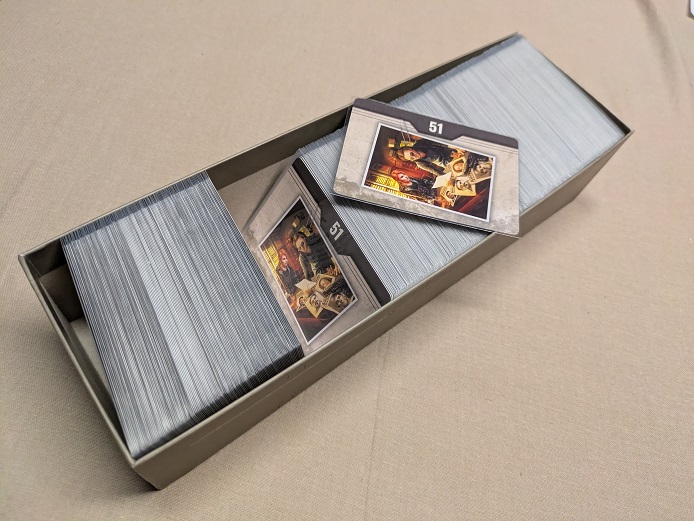
The card library is a concept that’s appeared in a few games. Fallout: The Board Game and Star Wars: Outer Rim are the standard bearers. This system is a large deck of cards where each is numbered individually. Other components – such as narrative encounters occurring during play – will tell you to reference a specific card.
So, say you’re chasing a suspect down an alley, but stumble around a corner and lose your footing. By the time you recover, you’re unsure which way they went. You can either head left into a busy street or continue straight to another intersection of corridors. If you head left, you’re instructed to draw and read encounter card 52. If you instead continue into the maze of alleyways, card 61. This is how it achieves branching narrative scenes with depth. You’re never reading from a book, but instead from a cascading series of cards. This makes for unpredictable trees of activity, particularly when you realize just how malleable this card system is.
Sometimes you will be told to grab a card and it’s a new item. This may be linked to the specific scenario you’re currently entangled with, or just a generic reward from a location investigation. Occasionally you will run into unexpected threats and thrilling skill tests. And, best of all, wild stuff will occasionally happen with serious results. If you’re riding these story snippets with a low stakes carefree vibe, you will run into events that really shakeup the situation with the force of a collision. The first time this happened it was gnarly, but it left me smiling with a renewed sense of respect.
The best part of this card system is its astute implementation of variability. Some numbered selections, quite a few actually, contain multiple copies of cards. For instance, you may find yourself caught in a biting acid rainstorm which of course results in a mutation. Why wouldn’t it?
As a quick aside, just so you know, half the population seems to be suffering from mutations in Old Angeles. Nearly every session a character or two will catch the bug, and it’s often hilarious and interesting. Anyway, back to our regularly scheduled programming.
But you have this mutation. You then must draw card 5, which has a half-dozen copies. This means you draw one of the options randomly. Each is different, so one may have you mutating into a scaled hideous beast, and another may have angelic wings sprouting from your backside. This variability is utilized throughout scenarios, events, and encounters. This is a chief trait of the writing in that it provides alternate pathways and outcomes. So, the conclusions to cases will vary, as will the culprits and villains. Not only does this work as a necessary prerequisite for repeated play, but it’s actually a huge incentive to discover various ways the case may develop. Often enough a weird and unexpected event will trigger, and after unfurrowing your brow you will look at the card library and see that two other options existed for that encounter card. Your insides will burn wanting to know what those other two possibilities are. It’s as if you can see the various suspended states of Schrodinger’s Cat yet the actual outcomes are blurred and just beyond recognition. All you can do is seal the box back up and give her another spin. In this way, one of the game’s possible limitations becomes an asset of sorts. You can get lost in these various narrative pathways forking through the card library, just as you can get lost wandering the streets of future Los Angeles.
Some of you may be shouting at the screen right now, rightly wanting me to credit this mechanism to 7th Continent. And that previous game does deserve recognition as a primary influence. A key distinction here is in how it creates distances from prescription in regard to scenario outcomes. The scenario structure of LA-1 is a lot more rigid and material than the curse format in 7th Continent. This results in a somewhat distinct feel, carving out some creative space to play in regarding forking narrative payouts. Its utilization in a more traditional adventure game format also unleashes new inventive pathways to tap into, and I would never describe LA-1 as riding parallel to that ambitious open world design.
Of course, just as we’ve seen in other games that utilize a similar card library system, there are diminishing returns. After several plays you will see repeated mutations and repeated location cards. But the possibilities are intriguing. I can foresee future scenario expansions such as the current additional case “When Laws Fail”, but also a more expansive extension that bulks out the card library and beefs up existing entries. This is where LA-1‘s modern sensibilities are most availed, as unlike Arkham Horror, it is designed to smartly integrate new content without going wider. Instead, it can extend its reach vertically and grow deeper. You don’t need to introduce a Madness deck with new rules and a requirement of setting it up each play, rather, you can add a chunk of new cards to the library and cleanly add this mechanism to existing scenarios or encounters. This is brimming with potential. It taps into the modern proclivity for content gluttony without some of the baggage traditionally associated. It’s one of the most exciting aspects of this game’s future and a large reason to hope for success.
One question I’ve been gnawing on is “what is LA-1 saying”? What’s the underlying theme of this work?
The main throughline which repeatedly draws my attention is the depiction of decay. This is most evident in the Darkness track. It’s the inherent pressure of the job. The pulsing heartbeat of the game. It’s tension and hubris and finality and death. It pushes you and forces you to push back. But there’s other sources of entropy. Locations shift to a dark state over time as the city sinks into depravity and hostility. Your sense of security is disrupted as these locations which previously offered unique benefits now inflict harm. Items also break down or are used up. They dwindle as you trigger them, disappearing nearly as quickly as they’re gained. This chewing up of matter is mirrored in your health. Wounds pile up leading to permanent injuries and debilitating ailments. The most severe are difficult to heal and stick around for the remainder of your time in this world. I mentioned status conditions earlier as part of the card library, the horrific mutations as well as some others like being wanted by the law, these are also bombs ticking away. Eventually your time runs out, and your fate must be reckoned with.
All throughout the design is deterioration. Everything is crumbling, breaking, and bleeding. Not just the people and the things, but the cases you work and the world they inhabit. It’s LA-1’s black mantra and it’s fascinating subject matter. What this ultimately does is inspire you to fight. To push back the night and rebuild what is broken. With courage and determination, the blight can be contained or even eradicated. It appears as if everyone and everything has been abandoned, and you’re the only one willing to do something about it.
I’m swooning over LA-1 but it’s important to pump the brakes a little. This beaut is imperfect. Firstly, I think it’s going to need more everything long term. If this game is DOA and never gets additional support, it will be a travesty. It’s setup in a way to push its contentification model and presents it to the players as a tease. It needs to ultimately put out.
A lesser concern is the scaling. I think this game actually functions adequately across all of its player counts, which admittedly is impressive. But it hits hardest with a group of two or three participants. This pocket allows for less downtime with a stronger support in remaining present and connected to the fiction. This is important because there are segments of this game that suffer from fatigue. The clue system can feel quite repetitive absent the narrative breadcrumbs delivered by the scenario, and you can get stuck in a soft middle portion of the game where the remaining clues are limited and you’re just churning turns trying to luck into encounters at the right location. There are tools to mitigate this and perform reconnaissance on the facedown tokens, but timing doesn’t always align and the experience can occasionally drag. Usually the scenario will grab a hold of you and lift you out of the doldrums before it’s too late.
While I think the writing is board game strong – I think you know what I mean – it pushes for a certain style that I find somewhat slippery. Too often it slides into cheesey humor, abandoning its gritty Blade Runner roots and shooting for laughs over grimaces. This doesn’t appeal to me personally, and fortunately the overall aesthetic requires interpretation and filtering to arrive at your own interpretation. This is a quality of its focus on emergent narrative, which produces situations and details without expressing specifics. I do wish it would have been calibrated more tightly around its influences.
The final detail I want to discuss in order to tamper down the extant enthusiasm is that this game is long and challenging. It’s an easy three-hour affair, maybe even four near the upper boundary of participants. You can shoot through it pretty fast if you’re experienced and so inclined, and it operates at a tempo unheard of at Arkham Horror tables, but it’s easy to drag things out with discussion or slow turns. You’re also likely going to lose. A lot in your early plays. The Darkness track feels generous. You will look at its slow progression and feel confident you have all the time in the world. You don’t. Its maw will open up and swallow your ragged souls.
Although, that last point is a positive for me. I want cooperative games to break my spirit. I want it to be an epic journey where victory feels extraordinary and not routine. I’m a sicko I guess.
And as a sicko, I don’t really want to put LA-1 down. It feels like a heater. Like a good book or television series, and I want to go just one more chapter. One more episode. I do find myself concerned about the content eventually becoming stale. This game needs to stand up and find its legs. It deserves all the energy and enthusiasm that lifted Arkham Horror 2nd Edition to new heights.
A copy of the game was provided by the publisher for review.
If you enjoy what I’m doing and want to support my work, please consider dropping off a tip at my Ko-Fi or supporting me on Patreon. No revenue is collected from this site or publishers, and I refuse to serve advertisements.


Sounds like LA-1 checks a lot of solid boxes. I’m sure this will come to a table near me soon. Thanks, Charlie!
LikeLiked by 1 person
Thank you, Randy. Hopefully you get a chance to try it.
LikeLike