
The instinct to build massive edifices, monuments, and works of art is primal. For animals like the Bowerbird, their elaborate mating parlors are practical. For humans like Jason Blake, their mind-boggling creations eschew practicality for ambition. The most honest assessment I can give of Cysmic is that it’s a boldly crafted reliquary to youthful mirth and toyetic play. It seeks to inspire wonder and awe, like standing in the shadow of the Burj Khalifa. To Blake’s credit, if you manage to heft this thing out of your gaming cavern and into the wild, onlookers will gawk and take pictures. They will ask questions. They will assume the role of tourists.
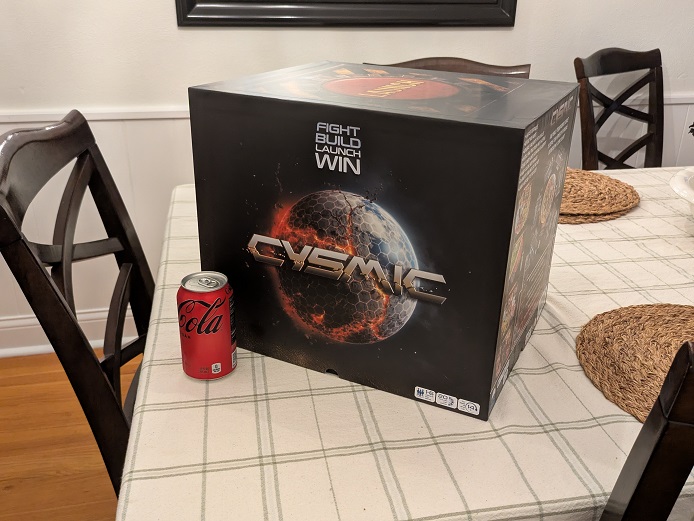
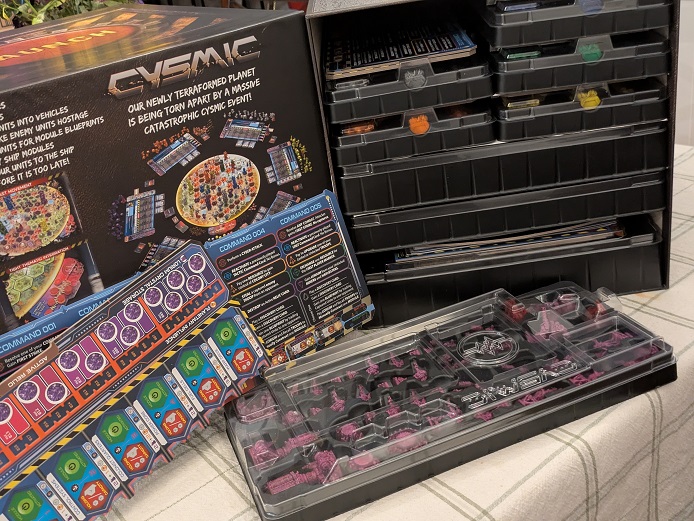
While it’s certainly a sign of the times, any proper discussion of Cysmic must be framed around its physical immensity. It’s gluttonous. Hauling the box to the table, much less to another bud’s home, is no small feat. It’s not a traditional box, instead it’s sort of an outer shell that holds several layers of stacked vacuform trays. Six player trays to hold all the various plastic miniatures and three large general storage containers for things like huge colony ship miniatures, 3D mountains, a hundred hex tiles, plastic resources, multiple decks of cards, and so on and so on.
Setting the game up is an adventure. The board depicts a massive planet that’s in the process of being strip mined and become unstable. Yes, you’re one of the greedy colonizers that has exploited the planet to the point its innards have swollen and begun to burst, tearing apart the geographic landscapes upon its surface. The board is large. It has to be to hold this game’s beefy viscera.
The board functions as a placemat for the six biomes and the 127 hex tiles. These are randomized within their respective biomes each play. This process is similar to setting up Cosmic Frog, which hilariously is much smaller despite its depiction of a battlespace for two-mile high toads. The point is this takes a while. An incredibly long while. The benefit is a terrain surface that is dynamic, exploding and reshaping over time as the cysmic (yes, that’s how it’s canonically spelled) activity rises. This is player influenced, with volatile actions resulting in more frequent tremors. Whole slices of the board crumble away with the possibility of units being devoured by the raging hellscape beneath.
This is pretty gnarly. I love the feature in Cosmic Frog and I love it here. Having to adapt to dynamic geography is one of the best tactical jolts these types of games can offer. It makes for unpredictable and wild occurrences, the type of events that freeze emotions for later thawing. I won’t forget the time my home territory blew apart, forcing my towering colony ship to shift on top of a foe’s badass mechanized powersuit, which was subsequently no longer mechanized and no longer badass. These are intense moments which force audible reactions, ones where Cysmic manages to justify its burden and display its creativity.
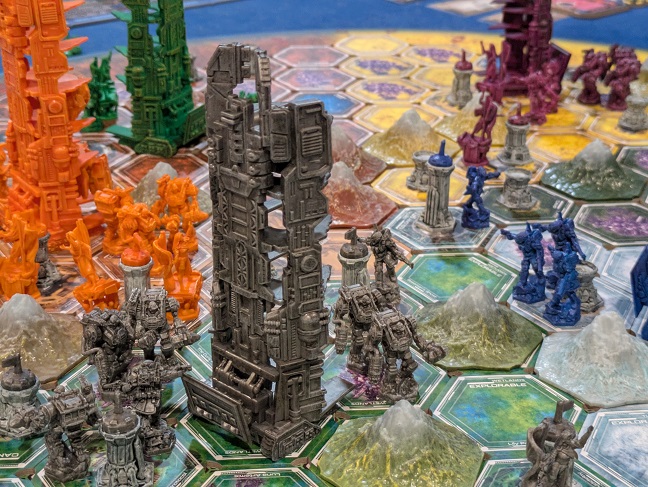
There are other moments where the weight of the boulder relents and you begin to float. The synthesis of handfuls of battle dice and supportive card play is a little finicky but tactically chunky. The general fragility of units and their associated cheap construction results in cascading waves of prickly hot zones appearing and fading all across the planet. Movement is free and easy to come by, the board even wraps at each edge to simulate its globe shape.
The action system is also interesting, presenting difficult choices of playing one of your cards and burning another, winnowing your available actions as the round progresses. These actions consist of activating every unit of a particular type – such as soldiers and miners – or performing a general action like recruiting new troops or resolving all of your battles. It’s very generous in general, never feeling parsimonious or restrictive. You can do exactly what you want and results are immediate.
That previously mentioned battle system is quirky though. The resolution itself is straightforward enough, or at least within the context of Cysmic’s excess, as you’re just looking to roll above target numbers and may modify rolls with cards played from hand. But when you engage enemies with your military units you simply pin them in place. They may stay that way for a while, frozen on the field and poised for carnage. The explosive finally triggers when you or the defender chooses to play “battle” as your action card for the turn. There’s an incentive to do so as it allows you to gain initiative in combat, which is separate from the benefit gained by the faction which actually initiated the pinning. That second status rewards a souped-up special die you roll alongside your unit granted strike dice. The defender gets a special die too; it’s just not quite as juiced as the attacker’s.
Confused yet?
There is a lot here. The process of learning the game is far more complex than the actual experience of play. A traditional publisher would have cut large chunks of this game, such as the bonus actions. Let’s look at those.
Each of your action cards is played above your player mat in the current slot for the round. At the bottom of the card are certain highlighted symbols. They correspond to special actions printed on the player mat in that column. Each column has different bonus actions, so there is considerable nuance in timing your activity. For instance, if you play your Soldier unit action card you would activate all of your soldiers on the board and then may perform a blue bonus action. If this occurred in the second slot, the blue bonus action would allow you to move your units out of a combat, negating their pinned status. In the third it instead allows you to perform an action on a previously played unit card. So, maybe you re-active all of your miners on the planet to bag a whole warehouse of Lorium and set yourself up economically. Maybe you don’t, as there are a couple dozen bonus actions in various positions allowing all sorts of clever nonsense. Players don’t even really understand the expanse of their capabilities until a play or two into the game.
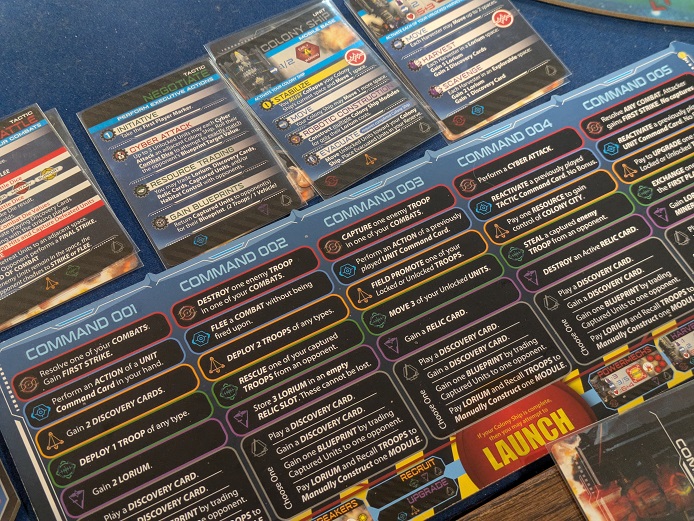
But cutting bonus actions would reshape the experience by restricting flexibility and reducing surprise. Likewise, if you tossed out the Discovery cards something material would be lost. These are separate from your actions and allow you to pull off secret maneuvers and one-time powers that can seriously whomp an opponent. These cards also double as the die modifiers in combat. A third type of card, Relics, are only relevant once the board has split apart and artifacts of an ancient civilization are exposed. These provide gnarly ongoing effects, but again, are entirely unnecessary.
Another item which would be on the chopping block is cyber warfare. This is a sub-system which is similar to combat, but it allows you to hack an opponent’s colony ship if you get units adjacent to it. You are rolling dice looking to hit specific target numbers to nab your adversary’s blueprints.
Oh right, blueprints. Another detail to be weighed.
Blueprints are a function of the game’s objective. You are trying to construct your faction’s colony ship so that you can be the first to evacuate the planet you aided in ruining. Use it up and spit it out, they say.
Blueprints are acquired by defeating a foe in combat. All of your enemy’s casualties are hauled away to your gulag for safekeeping. With another action, you may ransom these prisoners for the opposing faction’s blueprints. There is no negotiation here, as they can’t deny the exchange. Each blueprint is linked to a unique faction, which means you need to battle each other player on the board in order to fulfill this goal. Once you have the necessary blueprints you perform a construction action, spend some Lorium, and then snap a plastic ship component into the colossal colony ship miniature.
There are two things going on here worth calling out. First, the incentive to attack each other player and best them in conflict is a wise detail. It spurs aggression and softens the emotions of defeat, as you can nab prisoners even as the loser.
The second aspect that’s rad is how it interweaves the game’s physicality with its systems. This is the tough point where the miniatures come to life and embody the game’s spirit. You physically construct your colony ship, justifying its existence on the board as an enormous blind spot for those looking across the table. The magnetic connection of component pieces is satisfying, and seeing your objective come to life and develop in Lego-like fashion is a joy.
But yes, cyber attacks. These are an alternate method to gain blueprints that is less effective and broadly mimics the combat system. Again, not entirely necessary and a whole section of rules that could be cut. I understand this solves a rare problem that may occur if a player has no units on the board – and thus cannot be captured – but this status could merely award every player that faction’s blueprint on the spot.
So, you’ve battled your way across KEPLER-62E, beaten down each opponent, stolen their engineer’s intellectual property, and exploited your working class to build a massive transport. You’ve won, right?
Hold up.
Once you’ve met this goal, you may then attempt to evacuate at the end of each of your actions. It’s not guaranteed. You do so by rolling the conscience die, a custom six-sider displaying a range of numbers. The resulting value is the number of units you can stomach to leave behind. Roll too low and your university courses on moral philosophy bite you in the ass. You don’t want to be the one to push that button and condemn them to death. Just try again next turn when you’ve had more time to dismantle your ethical bulwark.
Oh, this is a weird mechanism. On one hand I hate the moral position which is imposed instead of organically germinated. This is the type of thing which hits harder upon reflection, instead of being shoved in your face and systemically enforced. But on the other, I appreciate how the burden of command and the human element is considered. It’s the type of thing that is unusual and interesting. But if this die was flung into the bin and never referenced again, would the experience suffer? There are about 20 layers here and each can be put under the microscope of this question.
Launching, by the way, consists of actually pushing a big red button. A large plastic tchotchke doubles as the first player marker. First contact with this game results in everyone wanting their chance to repeatedly depress the button, instantly transporting themselves to 1992, a carefree kid sitting under a Christmas tree and tearing apart their presents like a maniac. This garish prop is an accurate representation of this game.
The next excess I must discuss are the factions. This isn’t Rising Sun. It’s not Twilight Imperium. The asymmetry of Cysmic is more akin to Cosmic Encounter. There are over two dozen factions of varying difficulty, each possessing four or so unique powers. The first time I thumbed through these sheets I muttered phrases like, “the hell?” and “no way”. These are shocking abilities, like breaking the turn structure and moving other player’s units. I’ve seen troops cram into dropships and launch across the board. I’ve seen opponents strong armed into paying protection money. One player could redirect Cysmic activity and destroy adjacent spaces. There are so many weird and unexpected effects. Every single time I sit down to play this game, I rub my mitts together and brace for the faction options I’ve been dealt. It’s a thrill, and it’s incredibly surprising that they feel relatively well balanced. Without hesitation, the factions are my favorite aspect of this game, as the lack of restraint reaches peak creativity. It’s the one area of intemperance without friction.
Cysmic is confusing. It’s like a lover that communicates poorly, leaving you frustrated at times and ready to let them go. Then you have a wonderful encounter, something which leaves you enraptured and devoted. When I’m in the throes of it, tossing dice and slinging cards as I destroy waves of infantry while the world crumbles beneath my feet, I’m absolutely content. It’s a high tempo game where new units and rewards come cheap. Where battle is swingy and nothing is precious. Cysmic is sick.
And then the game ends. This is when I realize I have to put it all away. I have to figure out which pieces go in each tray and how to organize everything just so, otherwise lids won’t close, trays won’t interlock, and it all won’t fit back in the box. This can be more taxing than the experience of play, which is a breezy two hours at the lower counts.
This is another oddity I have to detour for. Cysmic scales non-linearly in a fashion similar to Forbidden Stars. As you add each additional player, it’s not just another 20 or 30 minutes tacked on to the session. Now, each participant needs one more blueprint, spiking the playtime in an irregular way. At the top limit, this game is incredibly long which is jolting if you’ve only experienced the game with a smaller crew.
But the low point is always at that conclusion as the emotional height of the evacuation roll fades into oblivion and the enormity must be reckoned with. Ugh.
This game brings back memories of 2012. That year, Christophe Boelinger teamed up with Z-Man games to release Archipelago. Retired critic Michael Barnes described it as a parody of the modern Eurogame, a design that crammed in as much as it could and knew nothing of restraint. He held, sincerely, that Boelinger intended this work as satire. That wasn’t the case, but this same thought could be applied to Cysmic. A cynic could reasonably view this game as a satirical representation of the crowdfunding genre. It has built in expansion modules and several modes of engagement, including a Euro variant with less conflict and an “autoponent” to support cooperative and solitaire play. It even – and this is not a joke – includes rules to use the reverse side of the board and included miniatures to play a full-fledged Chess variant.
Despite appearances, Cysmic is no parody. Blake clearly broke off part of his soul to complete this project. Nothing, and I mean nothing, was skimped on or shortcut. The core gameplay loop is interesting and boasts a suite of fresh ideas. But does it measure up to the best in the area control genre?
That’s the important question and it’s difficult to answer. The combat system is solid. The overall pace is excellent. The faction design is flirting with best in class. It’s a game of big turns, where you play a Soldier card as your action and then get to activate every single one of your infantry on the map. I wouldn’t call it tight, it’s almost obscenely permissive.
Some may not appreciate that it’s more of a race, one which prioritizes efficiency. The player that best navigates the matrix of actions, bonus actions, and board state while prioritizing speed will attain the best probability of victory. I’m not sure that framework is as compelling as those which focus upon infrastructure, engine building, or empire development across a longer arc. It’s a different feel, really.
Cysmic ultimately occupies the slot of a contemporary Cthulhu Wars, something which pairs exciting systems with stunning table presence. It’s an event game that draws a crowd. Criticism will always migrate towards its obesity masking a subpar design, but that’s not a fair stroke. This game is solid and thoughtfully designed. But there is always the risk that it flounders and proves too cumbersome. Or that you have a bad back and can’t even lift the thing from your shelf. If the experience fails to deliver, I guarantee you will be dropping f-bombs as you shovel pieces off the table and try to cram it all back into the box like a bedroom closet stuffed with junk.
Information on Cysmic, including how to nab one of the remaining copies via late pledge, can be found here. A second printing of the game will occur in the near future; you can check out that campaign page at this link.
A copy of the game was provided by the publisher for review.
If you enjoy what I’m doing and want to support my work, please consider dropping off a tip at my Ko-Fi or supporting me on Patreon. No revenue is collected from this site, and I refuse to serve advertisements.


The hidden-role system in The Presence sounds especially interesting, with players never being completely sure whether the ghost is helping or working against them. I also like how deduction, limited communication, and campaign progression create different layers of tension, something that makes games like C555 interesting to explore.
LikeLike