
Kasper Lapp, Voight-Kampff test, 10-minute social deduction game is the kind of pitch I hope to hear when riding the elevator. Lapp previously designed quirky hits like Magic Maze and That’s Not a Hat, so his brand of silly seems uniquely appropriate for this sort of nonsense. When it works the playful interrogation is both sinister and giddy. When it doesn’t, the quiz is about as lively as a four-year old replicant.
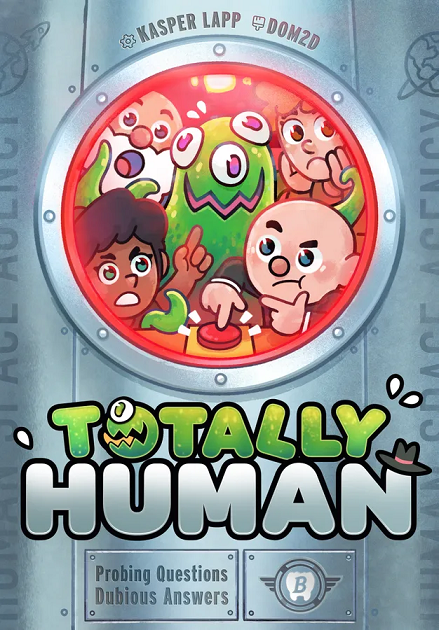
One of the odd things about Totally Human is that I have not been able to get comfortable in my own analysis. It’s a mishmash of interesting ideas that isn’t terribly smooth, yet I wouldn’t call it clunky. There are elements that are familiar, but on the whole, it’s foreign.
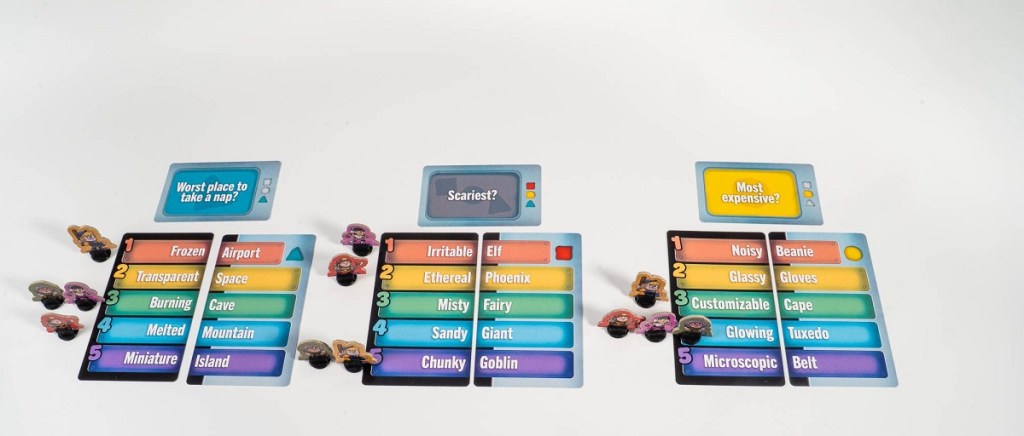
At the core of the experience is the aforementioned Voight-Kampff questioning. Roughly half of play is the group answering a trio of multiple-choice questions in a sort of reverse Apples to Apples sitch. Things like “which of these is the most expensive?” Or “which is scariest?” There are a lot of questions. The game is generous when it comes to content.
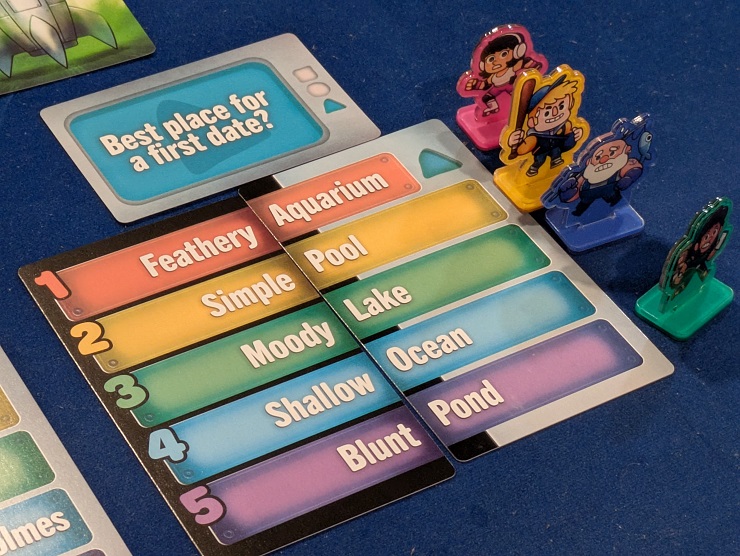
Not only is the question drawn randomly from a deck, but so are the answers. The multiple-choice list is assembled from two cards, one being a series of adjectives and the other nouns. So, you get ad-hoc responses such as a glowing waterfall, customizable desert, and microscopic star. There are some light guardrails to ensure the cards fit broadly with the category of question, but otherwise they are totally random combinations using the – I’m sure thoughtfully curated – answer cards.
Players decide what they believe is the best option and reveal their selection simultaneously. A nifty character standee representing each participant is placed next to their choice as a mnemonic reminder. There is no actual correct answer. There is rather logic, debate, and consensus.
The flow feels natural with discussion arising organically between questions. After some chatter, the group will move on to the next test and repeat the process until three total have been answered. But delightfully, there will be moments where everything is halted and people are called out.
“Wait. Jimmy, how is a microscopic star scary?”
Jimmy offers his best defense, “what do ya mean? How the hell did the star become microscopic? A star requires a large amount of mass. This isn’t Honey I Shrunk the Kids, and even if it is, how did Wayne point his electromagnet machine at a star? Something’s not right.”
“Why do you know the name of Rick Moranis’ character? You’re not right.”
This is the game. This is where Totally Human wants to live, not in its components or mechanisms, but in the space between, the space full of contention and wit. It gets there by forcing deceit.
Humans have an innate sense of freedom. They can choose whatever answer they’d like. Some of the players sitting around the table aren’t human. Some are aliens hidden amongst their prey and trying to blend in. Blending in is hard.
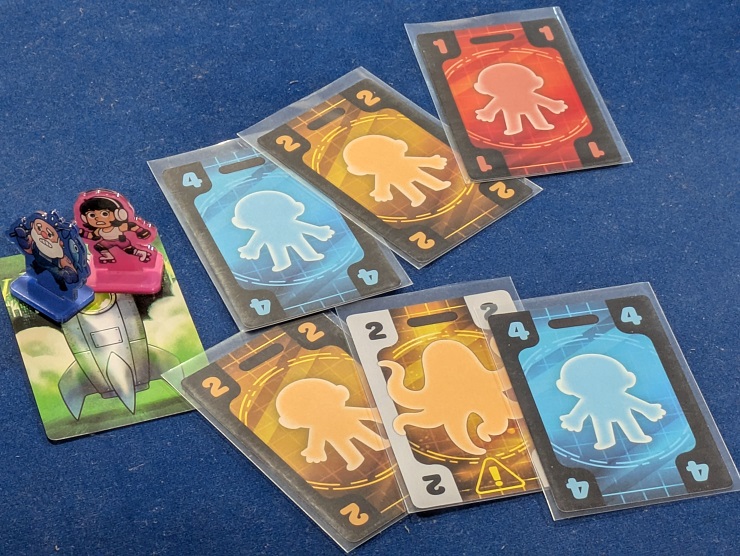
Your role is determined by three identity cards dealt to you at the onset. This is a little like the social deduction game Good Cop Bad Cop, with a couple of crucial differences. Here, if any of your three identity cards show an alien icon then you are straight up villain. If all are human? Well, then kick back and enjoy the show.
The difficulty is that aliens do not know how to blend in. They’re Leon sitting at the table, perturbed by the turtle on its back. Instead of answering freely, they must answer questions using the numbers dealt to them on their identity cards. These cards not only indicate your humanity, but they also come paired with a number.
Say you were dealt a 1-1-3 and you’re a vile extraterrestrial. It doesn’t matter which of the cards actually shows the alien indicator. You must use each of these numbers when answering the trio of questions. So, you will need to pick the first answer on a question, the first on another, and finally the third answer. But the order in which you select these is up to you. This means for the very first question card you could pick the third answer, which maybe is the microscopic star. You pick the third because the first answer is weak and you would have had a difficult time justifying it. But now you’re stuck selecting the first answer on the following two questions as you’ve used up your three. You do not see questions ahead of time either, so there is tremendous uncertainty in how your dwindling agency will align with the RNG of the interrogation.
This isn’t incredibly smooth, but it makes sense; particularly when you’re dealt the cards and have everything sitting in front of you to reinforce the concepts. As the alien, organizing your lies and bracing yourself with a hardy defense is absolutely necessary. You have to be clever, but also flexible and cool. Those who do not enjoy the anxiety and tension of being spotlighted in games like Secret Hitler and Spyfall may not get along with Totally Human.
Here’s the rub – the game works best when it doesn’t work at all. By that I mean that the experience delivers when the mechanisms grind and create friction. You don’t want answers that cleanly pair with questions. You want absurdity written by a Jell-O brained wordsmith chugging Red Bull. When the answers seem to align with the questions as if it was intentional, that’s when the fun is murdered.
This occasionally happens. A question like “most expensive?” with an obvious choice such as glowing tuxedo demands capitulation. When one player picks noisy beanie, everyone – even your neighbor trying to watch his Sifyl and Olly VHS collection in peace – is going to know you’re a little green bugger. If this happens, you’re just shut out of the game. Completely offed. No point in even trying to argue. It’s unfortunate because when the preposterousness prevails, the debate is amusing and engaging. Players are put on the spot and have to warp their brains to come up with details and color on why a fuzzy rock is lovable, or a foamy cave is a desirable homestead.
All of this discussion leads into the second phase of the game. Good news, this is one of those bifurcated designs where play completely changes part of the way through. While some don’t appreciate this juxtaposition, I’m actually quite fond of this approach as it provides variety and a whiplash which is much more interesting than painful.
The second act here is a really simple activity of having players negotiate their own transport manifests. For some reason the planet is exploding (is that really hard to believe?), and everyone is forced into evacuation shuttles. The problem is that this is where the aliens will make their stand, remove their masks, and swallow the plumpy humans whole.
The process amounts to players being able to move their pawn into a rocket. If it’s already occupied, all of the current inhabitants must agree. You are of course free to go solo and peace out. This isn’t heavily incentivized, however, as the good guys only win if they are on board the single largest human-only spacecraft. This means you want to usher in a large group, but you have to be extremely careful. Aliens win if they’re riding shotgun with even a single human. Chianti and fava beans. These win conditions are independent, so some aliens and some humans can share in victory.
Basically, this distills the somewhat convoluted climax of all the various The Thing board games down to a very simple yay or nay collective vote. This rushing about, knocking on doors, and democratic assembly occurs in real-time. It’s chaotic, which is great. Multiple groups may be negotiating simultaneously, and this atmosphere of bedlam is the backbone of the game. When things get quiet and no one is feeling cracked enough to deliver a monologue, that’s when the experience loses its oomph. If too many unforced errors occur in the questioning, this very well may occur.
I have seen Totally Human collapse on itself, the table shuddering in silence like a vessel imploding. This fosters a sensation of anxiety when introducing the game to newcomers, as I’m concerned one or more of them may be exposed by an unfortunate question/answer collection and left with nothing to do in the final scene. This indicates that it’s imperative the group keeps the final phase moving quickly. The experience works best with larger groups, but that enhanced participation means more bickering and an increased likelihood the game state stalls out. Everyone benefits from someone ushering the proceedings along, calling for final votes and avoiding those moments of prolonged analysis. You don’t want to sit there, pondering on who to let in your ship for five-minutes. State your case, make a decision, slam the red button. Fortuitously, Totally Human works more often than not. The final reveal of flipping up cards and checking identity is satisfying, often birthing dramatic moments that tilt the game in one direction or another.
Now, I wouldn’t strongly advise anyone pursue this if they can’t manage more than five players. With that being said, I have seen it work with as few as four, it’s just a little jankier and more unpredictable. Everything is more susceptible to congruence, with all but one player selecting an obvious answer and giving up the goose. With more people, there’s more cover. More voices speaking up and more passengers put under the hot lights of the interrogation chamber. You’re also likely to have strong personalities willing to muck it up and contribute. This design really begs for such players, as it wants discussion with a bit of an edge.
The most interesting quality of Totally Human is not its mechanisms or systems, rather, it’s the design’s stance on what it means to be totally human. There is a sly subtext that our humanity is grounded in communication and understanding. These are the foundation of culture, and they’re placed front and center in the game. But it all falls apart when we begin to turn on each other. When we deny those who carry the fire and instead let the wrong ones in. It’s wonderful that this emotional core is presented with such a brief and concise design.
It’s a shame the experience is not more consistent. This unreliability ultimately puts it at odds with its peers. The brief playtime manages to salvage disillusionment, but the engine misfires often enough to damage confidence. These sputters contrast with the moments of jubilation, the moments where players find themselves being totally human.
A copy of the game was provided by the publisher for review.
If you enjoy what I’m doing and want to support my work, please consider dropping off a tip at my Ko-Fi or supporting me on Patreon. No revenue is collected from this site, and I refuse to serve advertisements.

