
You can pinpoint moments where things change, where ripples meet ripples and creativity shifts. Dominion concocted deckbuilding. Love Letter gave the microgame sex appeal. The Crew pulled trick-takers from the ground like a necromancer. Now, Balatro is whispering in the minds of designers, calling forth Ace of Spades, Rolling Deep, and the subject of this review, Hell of a Deal. Cameron Reid’s fiery take pitches boss battling via cooperative poker. This design is clever and stoically cool. It blends a classic card game with hobbyist criterion to deliver something neither one nor the other.
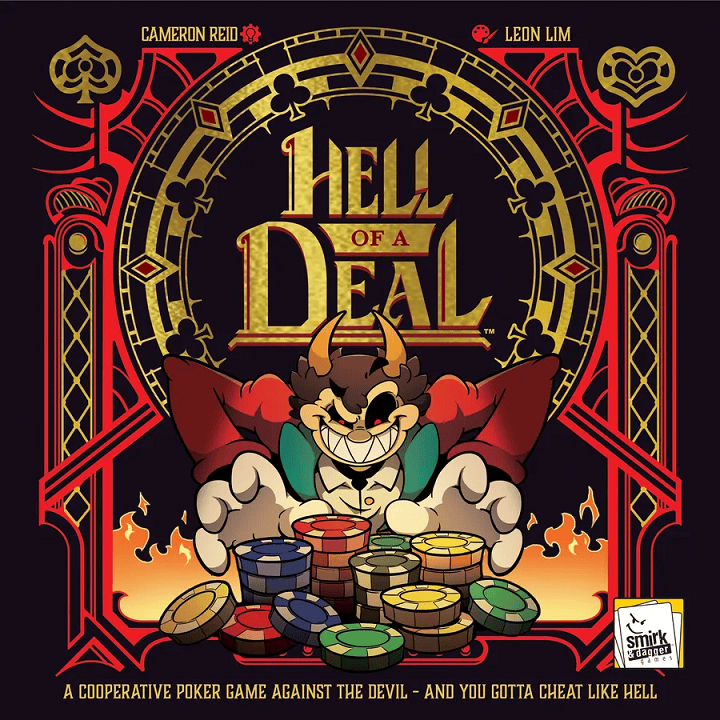
Hell of a Deal’s engine is Texas Hold’em. There’s a flop, turn, and river, with betting in between. While the booklet spends some of its budget laying out the rules of that popular card game, it’s hard to imagine anyone approaching this Smirk & Dagger release a virgin. The game would feel extraordinarily different in this regard. It would shift from an effectively light framework placed atop the familiar, to a complex card battler with obtuse rules. The more nuanced strategy would prove difficult to broach and I think this could be an altogether frustrating encounter. It’s certainly not an impossibility, but the obvious intent with this design was to inject hobbyist elements into a mainstream classic.
The existing knowledge does the heavy lifting. This frees up the complexity bandwidth to focus on novel concepts of cooperation and card manipulation. This is a game of working as a team to defeat a conga line of bosses, and in order to do so you will need to squeeze vigor from a suite of powerful effects. In terms of the game’s setting, it frames these various abilities as cheating, turning the devil’s tricks against itself in an ironically cruel twist of fate.
These abilities are driven primarily by betting.
Instead of wagering money, you’re tossing in chips which typically provide an immediate benefit. The risk is that if you lose your hand against the dealer, you suffer the cost on the back of each chip you’ve bet.
This downside exposure is pretty simple. You either accrue temptation or are afflicted with a curse. The former accumulates on a track and signals a game loss if two or more players cross the 10-temptation threshold. Curses are negative conditions which typically restrict play and last for a single boss confrontation – which is also a single poker hand.
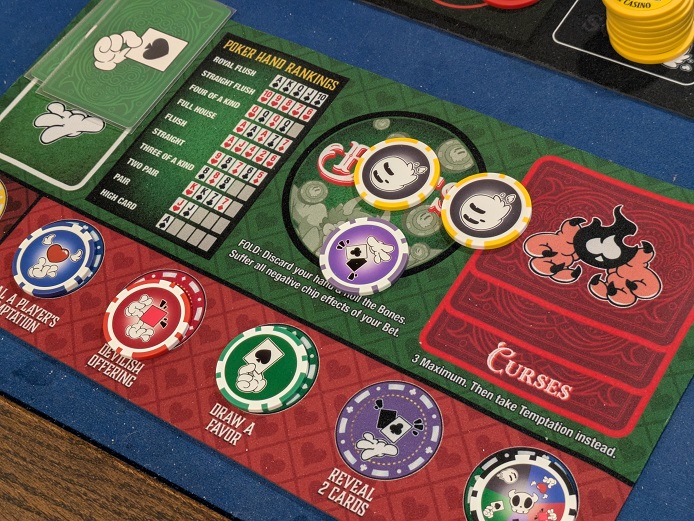
The positive effects are more varied. The most straightforward allow you to heal temptation or draw favor cards which provide their own single-use abilities. More interesting options allow you to manipulate the current game, such as revealing a card in the boss’ pocket, or trading cards between players. You can also top-deck new options, reveal two cards from your own hand, and wager precious souls. Souls effectively function as a primary life pool for the group. You shed them when you lose hands against bosses, and running a deficit against the final two foes is the second loss condition.
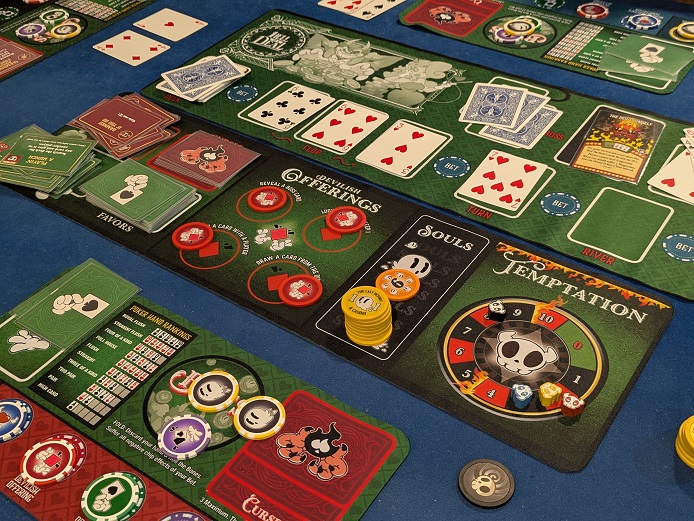
It seems like there is a lot going on here. That’s sort of true, but Hell of a Deal does a wonderful job through its user interface of clearly displaying each ability. This is accomplished through its trove of neoprene mats, each providing helpful tooltips on what the various chips do and how each power works. There’s no need for player aids as the game’s surface is lit up with useful information. This results in an incredibly smooth onboarding process for those familiar with Hold’em.
This is important because what’s interesting here is not structure, but strategy.
As a fully cooperative boss-battler, this game is a bit of a weird one. Players are individually comparing their hands with the game-run dealers in order to triumph and hopefully gain souls instead of bleeding them. This isolated comparison is a wonky setup that twists poker in a few interesting ways. For one, players can swap cards and may even sacrifice their own hand in order to improve one of their teammates. This can be difficult to accomplish, however, as information is heavily restricted in this game. In fact, this is a crucial element of the design.
A foundational rule is that you are not allowed to talk about cards in your hand. Anything faceup on the table can be discussed. This is why powers exist to reveal cards. Just like The Crew, you can signal certain strategic details or even just make specific things known such as laying down an Ace for everyone to see and telling the group you don’t need that card if anyone wants it. Because this is unusual, particularly if you’re approaching this as a poker player, there is some mental wrangling going on as you need to shift how you approach an activity which has pre-established conventions and heuristics.
For instance, it’s often the best move to fold early in poker. You cut your losses and can wait for a better opportunity. But because so much can be manipulated in Hell of a Deal, there’s a larger incentive to bide your time and wait it out. Opportunities arise that you couldn’t foresee. Sometimes your probability of success shifts drastically. There’s a satisfying convergence of agency and uncertainty in this design as it nudges poker closer to what we expect in hobbyist card games. This is really where it does the nasty and starts to win players over, revealing something truly compelling.
This also kind of puts the game in an awkward position. It seems to achieve maximum velocity with participants that have some non-traditional experience. Those friends who have played something a step beyond Catan, even if just once or twice. This game does not work as well as one may hope with a group of poker players that have not touched a hobbyist game. There are too many player powers to consider, too many things to track. There are unique boss abilities, teammates hands to keep in mind, card counting, and resource management. People that just want to play poker for money are not going to be amenable to trying out this quirky boxed game with knockoff Cuphead artwork. It is not at a gateway game to the hobby.
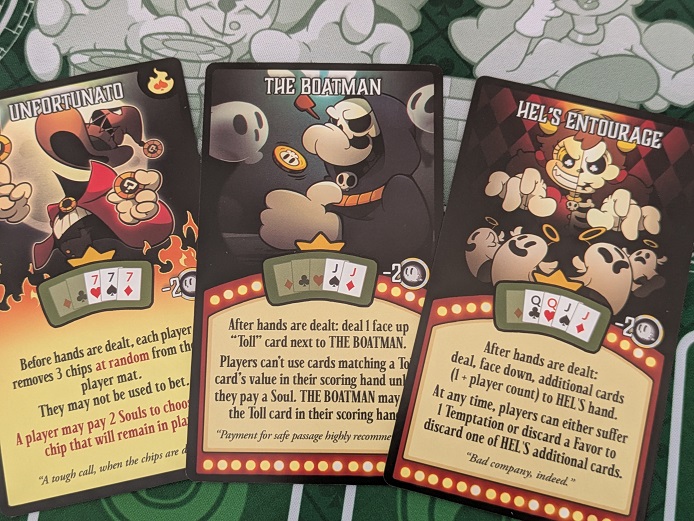
But with the right crowd, I think this is a very effective design. It’s successful in adding actual stakes to casual poker when there’s no sugar in the pot. To be frank, that’s a bigger accomplishment than it seems. There is a legitimate tension in this experience as you work to thwart six total bosses, including the devil himself. It’s not at all toothless.
From this perspective, I view the game in the same category as Regicide. Now, it’s much heftier in terms of components and moving parts. You can’t just play this with a standard deck of cards. But you’re using a traditional vehicle to run over bosses that want to eat your heart. It smartly weaves together a classic form with a new age glow up. Unfortunately, it also suffers from the same fuzzy communication rules where sometimes you’re not quite sure if you’re cheating. You also occasionally have hands where you no matter what you do, you just can’t win. It’s fundamentally poker afterall.
Most importantly, for those who enjoy Texas Hold’em, it’s exciting in novel ways. There are tragic moments of loss, thrilling standup reveals, and yet an oddly enduring laid-back atmosphere. This isn’t a brain-wracking game of carefully plotting turns or actions. It’s not a high-stress gauntlet that leaves you wheezing. It’s a chill cooperative bop that is serious enough to keep you focused. It has the energy of a filler coupled with the contentment of a fuller design.
By the same token, the ceiling is somewhat limited. Due to its carefree style and finite scope, it risks falling into the mushy middle of the current landscape. One odd thing is how it feels indifferent to the current contentification climate. I wouldn’t call it an iconoclast as this seems unintentional, but I find myself warped by modern design trends in a way that is making me question the limitations of this design.
What I’m getting at here is that this seems as if it’s just a mile short of a marathon. It’s not miserly in terms of content. There are 22 boss cards and an additional 22 hard mode versions of each. And yet, that doesn’t feel enough to really meet this game’s potential. It seems as if this big box should be paired with unlockable material in the spirit of the Dead Cells board game. Or another vector of variability such as a deck of global rule modifications with one card revealed each time you play. Perhaps an achievement system. Something.
The truth is the game doesn’t need this. But I’ve been conditioned to want that next level, something to compel me into playing the game beyond the mere satisfaction of the core experience itself. Most every game feels like the special edition director’s cut two-disc set now, which has altered my conception of possibility. Perhaps I’m broken. This is a quality card game with some keen ideas. It doesn’t need anything else at all. That should be enough. But, well, y’know.
A copy of the game was provided by the publisher for review.
If you enjoy what I’m doing and want to support my work, please consider dropping off a tip at my Ko-Fi or supporting me on Patreon. No revenue is collected from this site, and I refuse to serve advertisements.


The thing that doesn’t compel me to try this game is something you mention in passing. There are some hands you will win and somes hands you are gonna lose, no matter what. Such is the nature of Poker and not being incentivized to fold early seems a bit like …cheating. Like you can play as many hands as you want until you win. Like I know lifeforce is a thing but what stops me from playing over and over until the right combination of cards happens to come by?
LikeLiked by 1 person
You only get a single hand against each boss. You move forward against the first four bosses regardless of whether you win or lose. The final two bosses, someone in the group has to win against them to progress, otherwise you play another hand. However, if everyone loses against one of the final two bosses, it’s very likely you lose the whole game because you simply don’t have enough souls (life) to keep retrying. You might be able to retry once if you did well against the earlier bosses.
Trying over and over again is not a problem in the game. The randomness inherent in poker, however, can be frustrating for some.
LikeLike