
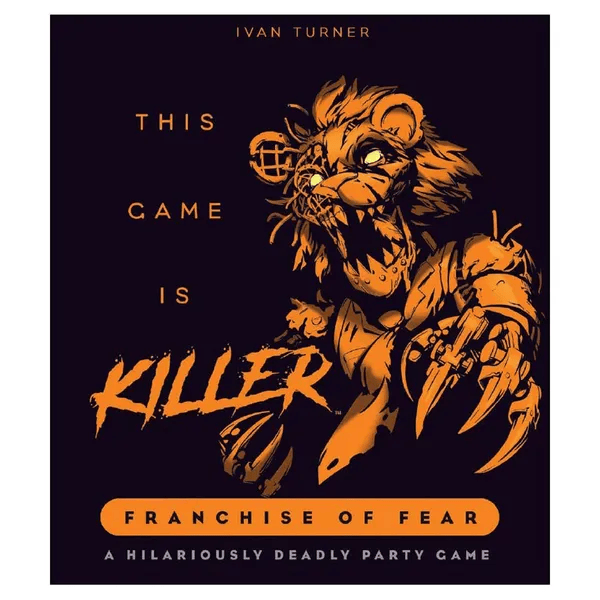
Ivan Turner is digging deep to bring us the third installment in his This Game is KILLER franchise. I was pleased with the initial offering, a riff on Ridley Scott’s Alien that took the form of a half hour semi-cooperative party game. Players slink about their ship, attempting to stave off death and kill the xenomorph hunting them. Often these hooligan crew members destroy everything but the predator, including each other and their ship. It was lightweight yet possessed a touch of the maniacal. I unfortunately never caught the sequel, which was an adaptation of John Carpenter’s The Thing. This 2026 filing hits upon the delirious Scott Cawthon video game turned Emma Tammi directed horror flick Five Nights at Freddy’s.
There’s a reason why I had to look up who directed Five Nights but did not need to do so with those other two films. Unfortunately, this adaptation similarly skids across the pavement lacking the verve of its priors.
The setup is promising. It’s derived from the same core KILLER engine of players being dealt two multi-use cards. They’re forced to play one to serve as the location they will occupy this round, and the other for the effect listed. This is a slick little mechanism to force players into a narrow yet impactful decision. Agency is relatively low, but this is a short party game that you partake in to see wild stuff happen. The lack of control is just part of the deal.
Layered atop the card play is a new power system. This ties into the setting with the restaurant you’re occupying suffering from a dwindling power supply. Each card you play for its ability sucks some of this juice. If the power meter goes completely dry, y’all lose. This is anti-climactic, but it’s a very rare occurrence. Mostly, this system serves to place an additional pressure point on the card selection. This sounded intriguing. It turned out to be low voltage.
It’s a small amount of additional rules heft that, frankly, isn’t moving. It requires more admin work in a game that desires a high tempo. It also hasn’t impacted many of my plays, bringing into question whether it’s significant enough as a device to justify existence.
This speed bump in pacing is mimicked in how Snapjaw, the animatronic KILLER, activates. The Five Nights remix continues here with four security camera cards randomly placed around the neoprene board. One of the cameras shows a deranged image of this robot furry on its face, while the others display static. These are flipped faceup in the resolution phase, with Snapjaw attacking from the entry point with his CCTV mugshot. It effectively randomizes one of four attack vectors each round.
This appears outwardly clever, but in practice it’s another task that must be performed habitually as you shuffle these cards and lay them out. Some actions allow you a peep at the cameras and a possible reshuffle, causing additional motion blur. The row of random room cards in Alien on Board was simpler and, more importantly, smoother. These two deets of Snapjaw’s attack and managing power create an entry point for clunkiness. The game loop is pricked by these processes and the discomfort is apparent. These elements don’t upend the experience, but the engine sounds like it has a slight knock.
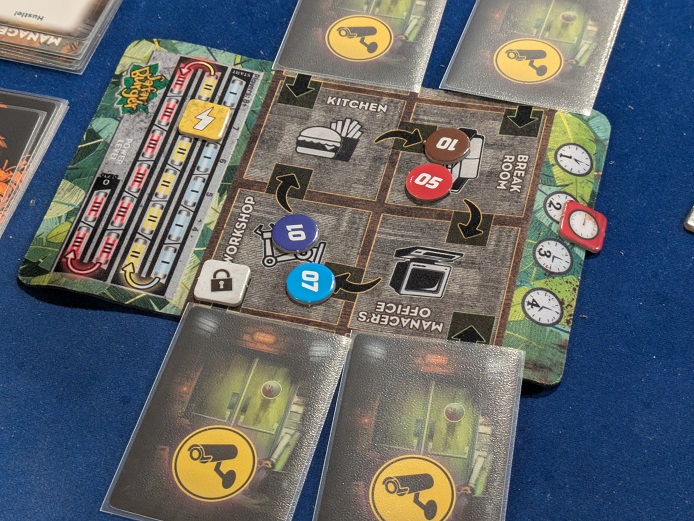
The other large alteration to the format’s structure is a serious compression of the game loop. How this plays out is that the KILLER attacks one of four rooms but then continues bouldering through the joint in a clockwise fashion until this Chuck E. Cheese bastard finds a victim. It’s ruthless and gives the villain an unrelenting vibe similar to Jason or that creepy thing in It Follows. That concept is promising, but the near guarantee of a player kill is less convincing in practice.
Snapjaw chews through victims. This is wholly different than Alien on Board where the xenomorph will often strike empty rooms and then fade back into the shadows. I imagine this new design attempted to stave off the problem of ho-hum turns where nothing happened. It also shortens the length of the session, which means players don’t have to wait as long on the sidelines after being torn apart.
This fit seems strong. The Five Nights at Freddy’s setting is campier, and this shorter and more explosive arc should fit the sloppy nature of the motif. That is partially the case, but unfortunately, I find the rapid slaughter too much. There’s no room for memorable moments to materialize. No real sensation of situation development or thoughtful play. We toss out some cards and the show cuts off in 10. It’s too brief and nonchalant.
I know, this criticism contradicts my earlier complaint of the new processes slowing momentum. This really gets at what I find off-putting about this iteration though: the pacing never feels comfortable. There are times when it needs to accelerate, and others where it would benefit from pumping the brakes. Much of it is unsatisfying. I’m not expecting deep strategic play or overly meaningful decisions, but I do want to squeeze more from this design. The effects on cards are less interesting all throughout. I find myself missing options such as the Burke-like corporate traitor or the ability to cryofreeze yourself and take a breather. This makes it nearly impossible to thoughtfully recap each play with the same verve as its predecessor. It’s difficult to place any emotion at all into Franchise of Fear, because it’s so short lived and by the book.
The breakneck tempo in terms of body count facilitates a dizzying sensation that’s similar to the shaky camera technique in film. While handheld and unstable camera techniques are quite old, Spielberg’s Saving Private Ryan seemed to cement this method as a modern staple. In the years that followed, many movies have shown an overreliance on the technique, sapping conviction and making scenes impossible to discern. The essence of Franchise of Fear is lost in this similar approach, with slashes and bodies flying about so quickly as to undermine any real emotional anchoring.
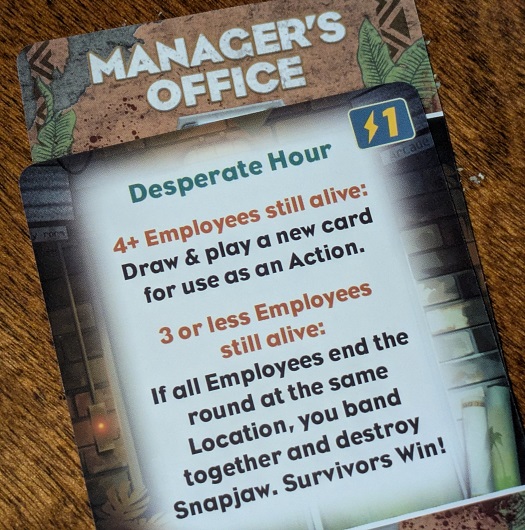
I am impressed that Turner is able to deliver multiple titles spawned from such a slight mechanism. The two I’ve experienced are surprisingly different, enough that my criticisms are substantial enough to sever my opinion between each. I can appreciate this boldness as opposed to merely reskinning the earlier work. Truthfully though, I would have liked to see the alterations push the game into a middle ground between the buzzsaw that is Franchise of Fear and the more deliberate hunt that is Alien on Board. While the dead spend less time watching, the impact of being offed before the ride even gets going is tough to swallow. The pile of tradeoffs is ultimately unbalanced. It’s possible the middle child, Frozen Horror, delivers on my longing and arrives in a more formidable position.
This new effort hasn’t spoiled my appetite for this style of game. The thematic filler is a rare breed. Usually, this slot is stuffed with card or bluffing games. Trick-takers in particular have come on strong and seem to dominate the space. I still have a burning desire for an efficient cut of old-school Ameritrash, one where players can revel in betrayal and bathe in drama. Franchise of Fear may not fully provide, but I remain optimistic in the promise of this series.
A copy of the game was provided by the publisher for review.
If you enjoy what I’m doing and want to support my work, please consider dropping off a tip at my Ko-Fi or supporting me on Patreon. No revenue is collected from this site, and I refuse to serve advertisements.

