
Grabble sounds dumb. You take it off the shelf, remove the lid, and put the game box in the middle of the table. The box is the playing arena, so yes, I’m hitting you with the “place the board in the center of the table” instruction. In the box is a bunch of junk. Shiny pigs, wooden Gs, ordinary dice, golden bananas. The yoozh.
3-2-1; the frenzy begins.
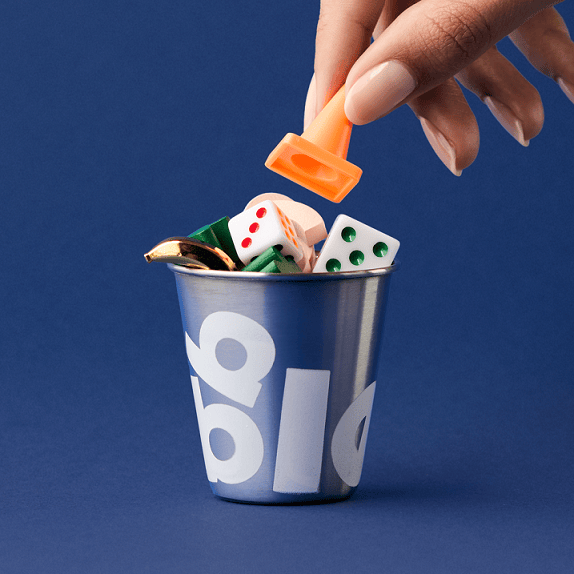
People thrust their fists into the box and grab pieces like they have a gun to their head. You take one tchotchke at a time and drop it into your metal cup. Then you repeat, stuffing your bucket until it’s overflowing like a Kallax.
The clickety clack is tactile nirvana all the way down.
But a game where you just grab pieces from a box sounds dopey. Give it five-seconds and that skepticism turns into grins and squeals. Having a slap fight in a ball pit of knickknacks is simply titillating.
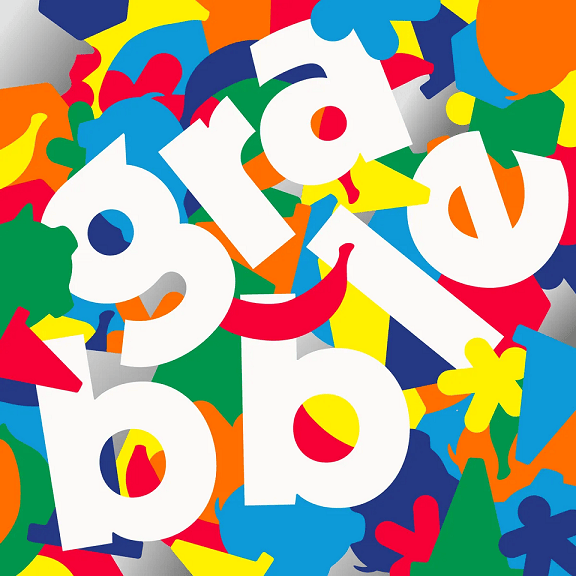
To some degree Grabble is a universal salve to the doldrums. Its visuals are immediately magnetic as it’s bursting with color and interesting shapes. One of the best features is that you start playing immediately.
It reminds me a little bit of Gigamic’s Tutti Frutti, in that it’s a category of game that you just plop out on the table and begin. No setting up. No long-winded explanations. No rules questions after the brief. Grabble’s instructions are so short in fact, that the game features a throwback to the Dark Ages with rules on the inside of the box lid. If you hate this decision for functional reasons, don’t sweat, for one who understands how to play Grabble will never forget. A few decades from now you can track me down in the memory care unit and throw this game on the table. I will school you.
You already understand most of the rules from my lively intro. I held back the really clever portion, however. At some point in the feeding frenzy, your bucket will be full. You don’t want to overstuff the sucker, as any piece that falls out of the container causes you to pause the grabbing and put the fugitive back in. Even a momentary pause in Grabble is consequential. So, instead of creating a mess, you will likely decide to trigger the end game. This can happen at any moment. As Neil Fallon said, t-minus whenever it feels right.
When someone decides to grab the chubby pawn in the middle of the box, they begin a countdown from three. The last player to stop grabbling has to gift one of their pieces to the one who started the countdown. This player-driven finale is fun. It’s a typical device in real-time games as it creates an invisible hand of pressure. Each participant must be wary of the end of the road appearing out of nowhere, so get ready to stomp the brakes.
The best part of Grabble is after the furor. Everyone dumps their bucket and covers their score with a hand. Then, the person who pilfered the pawn begins the bloodbath. They name one of their pieces and every player must toss one of these objects back into the box. Don’t a shiny banana? Get wrecked.
Anyone coming up blank is gone. Eliminated. Next person clockwise. Name a piece, everyone spit it up. This continues until only one player remains.
This simple procedure is surprisingly entertaining. While perhaps somewhat distasteful, my collective adopted a convention of declaring “BOOM, headshot” in a First Person Shooter/Quake-style deep timbre when someone is eliminated on the very first piece call. Several minutes of frantically shoveling garbage into a can and then you’re instantly gone due to neglecting little traffic cones. I think I’ve seen more laughter in these brief moments than in any other structured game I’ve played in recent memory.
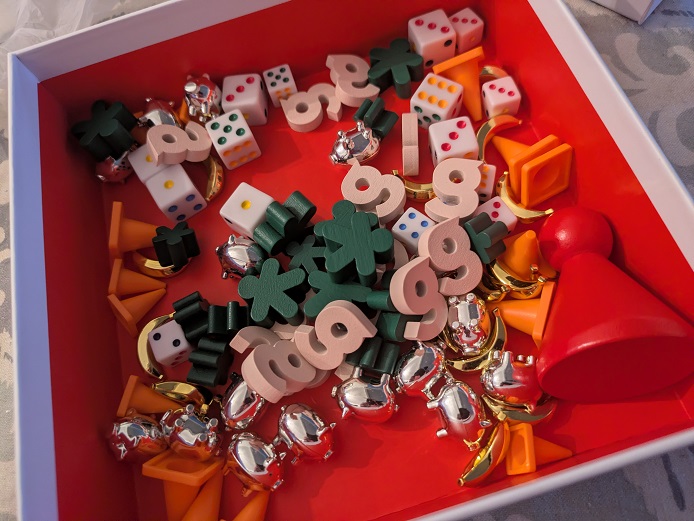
This game has a couple subtle design quirks that are praiseworthy. I’m talking about details such as having the pieces exist in two sizes. You’re strategically served to grab the smaller version of each shape so you can cram more into your junk drawer, but in the fast-paced blood sport of Grabble, you’re more likely to connect with those larger pieces and not spend the moment to make the best decision. This is also affected heavily by the kinetic bumper-cars occurring as other people’s fingers and hands collide with your own.
Another clever touch is the mechanism for removing pieces in the final act. There are some elements here which make you consider how to approach the real-time phase. For instance, if you overload on a couple of pieces and grab the pawn to initiate the countdown, you may be able to eliminate multiple people in a larger game by then gunning for those majorities you have accumulated.
I also think this game throws its weight around with surprising force due to the exceptional product and graphic design, and how in true CMYK fashion, it connects with the ludic elements in a way that elevates the entire activity. There is something about this publishing studio’s artistic approach, where each product is wholly committed to an artistic vision. I feel this strongly in Magical Athlete and Hot Streak, two other recent CMYK releases, where the act of playing is intrinsically wed to the aesthetic. You feel the visuals of the game during the course of play, and there’s a oneness to the experience.
One of the great qualities of simple games such as this, are how they work as a reminder to the simple joys of play. They cut out a lot of the noise in board gaming and provide strong clarity on how essential and beneficial play is for everyone. It’s easy to feel present and connected to something in this game, which is directly counter to the superficial fractured interactions occurring in our digital life. More sophisticated games do this too of course, but games like Grabble sit closest to the foundation of the activity. It can act as a confirmation of why we engage in this hobby and choose to spend time with people in this way.
Grabble is great. It’s difficult to knock the game due to how much it leverages so little effort and such a slender ruleset. The biggest shortcoming of these types of EP-like cuts is that they can struggle if you evaluate them on even footing with something as robust as Terraforming Mars or Gloomhaven. Just as board games can be these finely wrought cerebral epics, they can also be finely tuned jolts of recreation.
This comparison is absurd of course, but it is important to set expectations accordingly. You don’t play Grabble repeatedly in order to improve your strategy or understanding of the game. You play it repeatedly in order to live vicariously through someone else’s new experience, or as a nightcap after a delirious run with something more exhausting. It’s a way to splash some lighter fluid on your soul, rekindle a smile, and physically connect with another human as well as yourself.
A copy of the game was provided by the publisher for review.
If you enjoy what I’m doing and want to support my work, please consider dropping off a tip at my Ko-Fi or supporting me on Patreon. No revenue is collected from this site, and I refuse to serve advertisements.


Grabble is one of the better true filler games of this year. It’s like 5 minutes long, and still has enough of a game to be entertaining.
LikeLiked by 1 person