
There are moments in life that are intractably written into my consciousness like images chiseled into bedrock. These are important things like the day I married my wife and the first time I saw my child. Some are less important – but still meaningful – like the first time I watched The Matrix or held an NES controller.
Gen Con 2015 was such a moment. I will never forget that first play of Blood Rage. I will never forget the disgust rising from my gut in the wake of a Loki trick, nor the thrill of slamming down the fire giant and shaking the world. That feeling of wonder and drama is the emotional substance I’m chasing every time I sit down at the table.
Blood Rage is one of the best experiences the hobby has to offer. It served as the peak moment of Ameritrash/Euro hybrid design, crystalizing many ideas that had been germinating for years. The era following is less distinct, with nearly everything hybridized to various extents. This game was as important as it is exhilarating, and it’s the pinnacle of Eric Lang’s work in the field.
Blood Rage: Valhalla, despite any doubt, has allowed me to experience that euphoria all over again.
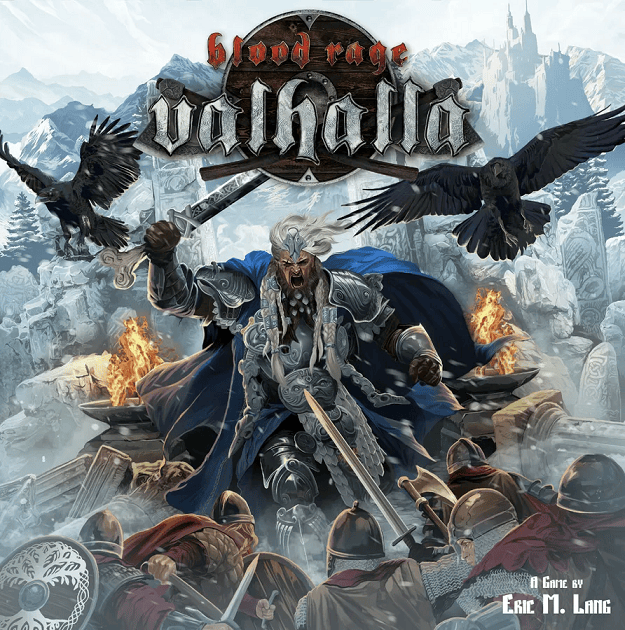
There’s a lot of noise running interference; Tycoon Games taking over CMON’s intellectual property, a wobbly crowdfunding campaign, a fervent player-base. But cut all that out, and what we have is a unique opportunity to experience something special, something that is both nostalgic and novel at the same time. This is the story of this game.
The issue with Blood Rage is that it grew old. Lang’s seminal work suffers from a static card pool with thoroughly developed strategies that have been curated through years of play. I have layers of heuristics established on what to draft in each age, with sets of priorities and contingencies. It’s still a glorious game, but one that’s become shaped by exposed probability, rigid expectations, and a geriatric meta. The fire giant is no longer a thrill, but a calculation on its cost and value vis-a-vis the game state. This isn’t the game’s fault. It’s earned its playtime and every session has been a joy.
But sometimes, you forget what you’re missing. Blood Rage is almost entirely content driven. By that, I don’t mean that it is reliant on expansions or needs a whole host of boxes to succeed, but the cards you draft each round are the main determinant of the experience. The rules are merely a structural foundation for that card-driven play to sit upon. Each round, you draft battle cards, upgrades, and monsters to terrorize your opponent. There is asymmetric development through tableau building, great upheaval in battle, and wild swings due to enormous beasts entering the fray. All of this is terribly exciting at first, but that exhilaration diminishes with familiarity.
Arise, Blood Rage: Valhalla. All new content. A whole fresh set of cards ready to be explored, combined, and flirted with. Imagine Race for the Galaxy getting a sequel with a wholesale change of the deck. It’s wild and exciting. For a group of veterans, every pass of cards in the draft elicits comments.
“What…the…fu”
“Whoa! That is nuts.”
“I want ALL of these cards.”
I can’t shake the image of a kid in a candy store and they don’t have enough pockets.
It took me right back to 2015 and made the hair on the back of my neck stand tall. And then this excitement and awe is reverberated when you chain together Skal! with Thor’s Favor and earn 40 glory in a single battle. Other people protest. Then they protest some more when you play Trickery and steal their card. And again when you keep setting aside and replacing battle cards with Himinbjorg and All-Seeing Eye. It’s a deluge of dramatic action.
One thing that’s overlooked with thematic games – what we historically called Ameritrash – is that extreme familiarity often degrades amazement. I’m not saying I exhausted Blood Rage or I’m worthy of competing in high level tournaments, but I’m saying there is a certain point where your engagement with a game shifts. More emotional experiential play is replaced with contemplative strategic refinement. This can result in the excitement being dulled. It’s a tradeoff of course, as becoming deeply familiar with a game is its own special reward, one which many of us don’t experience as frequently as we’d like in the current hobby environment. I feel thankful that I was able to play Blood Rage with such dedication and will likely play it again in the future.
Now, of course, I believe the industry has gone too far. Day one DLC and shelves full of content is not the way. We need to get back to the old method of releasing expansions over a longer period of time, when a game could benefit from a jolt. This also allows the necessary space for reflection, for designers to address a game’s deficiencies.
Blood Rage is ready for such a jolt.
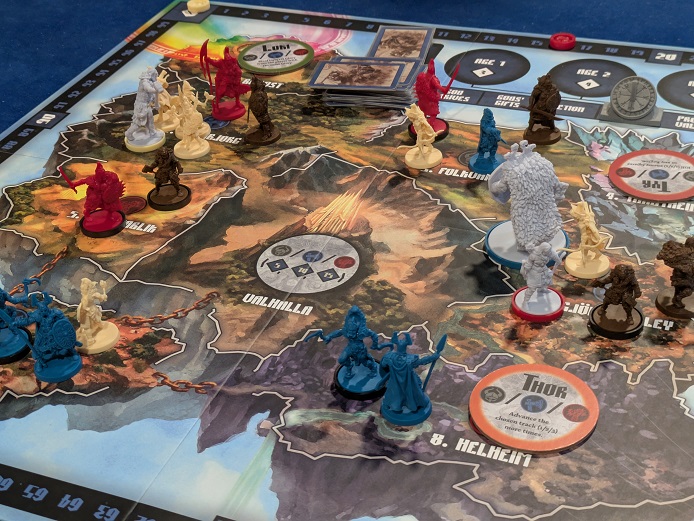
This is what Blood Rage: Valhalla is really about. It’s Eric Lang’s opportunity to return to his beloved child, lance its wounds, and elevate it anew. This is immediately evident in the structural changes. Things such as no longer being able to reinforce battles with an entire army, as each player can only move in one adjacent figure. You also can’t pick up and move troops all the way across the map, again, restricting the activity by adjacency. Both of these tweaks seem to elevate strategic planning with a renewed emphasis on positioning. They replace the original’s limit on the number of figures that could occupy an area, and in the process, address degenerative play.
One of my favorite tactics in the previous title, due to its devious and potent nature, was to take over an area and lock it down. If you hold every space in a region, no player can physically move into it. This was extremely beneficial in questing and in tempo control.
Quests are a key element of Blood Rage. They are drafted cards that provide hidden personal objectives which serve as an alternative pursuit to battle. In the progenitor, they commonly required you to hold certain areas of the board. This was often trivial to accomplish, and incredibly easy to abuse if you lock down all of the spaces of an area. Holding a territory in this way also affords unprecedented agency in ending the round. This is because the age doesn’t conclude until each area is pillaged, so you could preserve the space and hold off on raiding it. This was clearly bending the system in a way which excised the blood and rage in Blood Rage. Lang has fixed this. The game has been re-oriented to focus on violent conflict as opposed to dodging it. This philosophy is reverberated throughout the quest and upgrade cards, as well as the changes to the foundational rules.
Another smart adjustment is the additional areas with high-level rewards for pillaging. These include three god spaces that are activated slowly over the course of play. They map to a trio of deities selected before the session, with each bestowing a unique benefit on a randomized region of the board. Effectively, the game has four spaces in the final age of equivalent significance to the original’s Yggdrasil. There’s also this neat effect of broadening scope as these god regions become available over the arc of a session. This is entirely opposite of Blood Rage’s winnowing of territory, which pleasantly helps in separating the two games’ identity. One feels like a world cracking apart, ready to sink into oblivion. The other, a plane materializing and coming into existence.
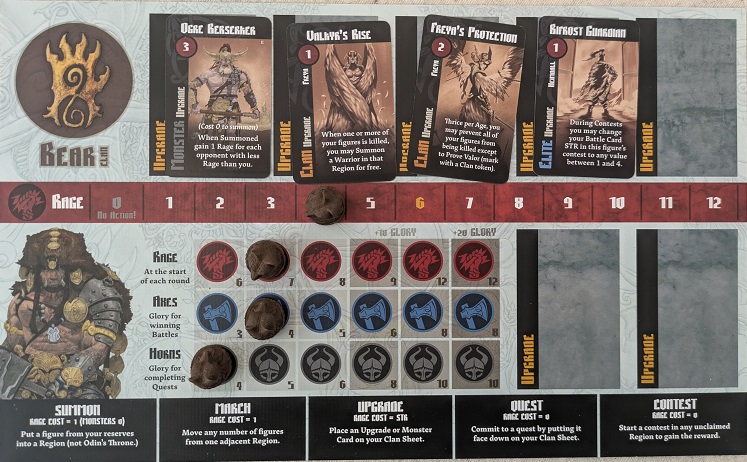
The pantheon of gods also influences the content pool. Each adds a block of cards that make up roughly a third of the deck. Of course, they have their own unique personalities and spheres of influence. Loki, for instance, is still the lovable loser. Thor wants glory in battle. Baldur is concerned with quests. And so on with Tyr and Freya and the others.
What’s evident in exploring these deities is that Lang has liberally embraced power creep. This materializes as a relational descriptor of the transition between the original game and Valhalla. The combinations of abilities and the absolutely wild stuff you are able to pull off is stunning. There are certain card effects in the previous game, that when layered, nearly break the design. These can be headed off through the draft or countered with another obscene combo. This quality is more present, more conspicuous, and more vulgar in Blood Rage: Valhalla. It intertwines with that sensation of novelty to turn your stomach inside out. At times it doesn’t feel fair, but more often, it feels explosive in a way that games frequently are too timid to embrace. All the boundaries are illusory and out of sight. The whole thing is lifting off the rails a fraction of an inch more with each turn, ready to fly apart by the end of the third age.
What a feeling.
One of the traits feeding this sense of ferocity is the reconfiguration of abilities to scale by age. In the original Blood Rage, each of the three ages had their own deck of cards. Power scaled linearly with each passing era, and the most powerful cards appeared in the third act. Since cards are no longer segregated by age but instead by god, that previous system was replaced with embedded power scaling. So a card that awards you four glory per figure killed in the first age will award five in the second and six in the third. This growth is included in the text on the card itself and a major feature of the design.
What’s killer about this methodology is that it allows you wider range to build your tableau. Since cards only increase in power, your engine doesn’t constantly have to turn over. Instead, you can slowly tweak it over the course of the game, creating enormous breadth in scope.
One of Lang’s key shifts in this design is allowing players to commit to builds and really ride them into the ground. This is also evident in the ability to carry forward three cards from the previous round. This means you can keep that Loki battle card you drafted in the first age for the entire game, continually going back to that well. It’s fascinating and terrifying all in one breath.
There is, as you’d expect, a tradeoff with this approach. Everyone else at the table keeps seeing that Loki battle card. There’s no escaping it and precious few ways to dislodge powers. This coalesces with another characteristic I’m not fond of in that many of the cards have duplicates in the deck. There are commonly three instances of an effect. This leads to less asymmetry around the table and the possibility of sessions being dominated by specific combinations of powers. The overlap isn’t attractive, especially for the player or two on the outside looking in.
All of this is worsened at higher player counts. It’s surprising that Tycoon Games included native support for five players, which the original game lacked. But I’ve found that a full table results in the most absurd combinations being stretched to their utmost. This is because many effects trigger with battle, such as gaining rage whenever you join a contest started by another player or being fed glory during certain conditions in a contest. With five players, there is more conflict and certain effects seem to benefit exponentially. The valuations of cards get a little wonky at the upper end, and the gulf between those at the top and those at the bottom starts to resemble the real world.
Let’s get back to the good stuff. One of my favorite details of the new card system is the unpredictable nature of each age. As I mentioned, all three chosen god sets are shuffled together into one large deck. You don’t know when a specific upgrade will pop out, or even if it will as some cards are inevitably never drawn. The tenor of play is altered in various intriguing ways depending on which mixtures of abilities appear. The game feels very different if Thor’s Glory is selected early or if a couple of extremely potent monsters emerge from slumber in the final act. Even playing with the same three gods produces largely different contours game to game. This is marvelous and a whole new strategic framework.
What much of this amounts to is an unyielding dynamism within the system. This spark is what Blood Rage originally promised in 2015, and what it’s delivering again in 2026. Lang’s mastery of drama and empowerment is at the fore. One of the most compelling aspects of this series has been its immediacy and efficiency in delivering momentous swings. This is everything I want from a progressive area control troops on a map game.
With Blood Rage: Valhalla, the scope is simply larger. Lang is evolving prior concepts, such as the various card sets in Rising Sun, as well as the focused shift to positioning and forward planning, something we saw in Ankh. There are touches here and there that seem natural progressions of previous ideas, some decisions which clearly indicate an unease with where certain strategies and exploits existed in the past. The historical view of all of this is captivating.
The future is just as inspiring. This game has muscular legs.
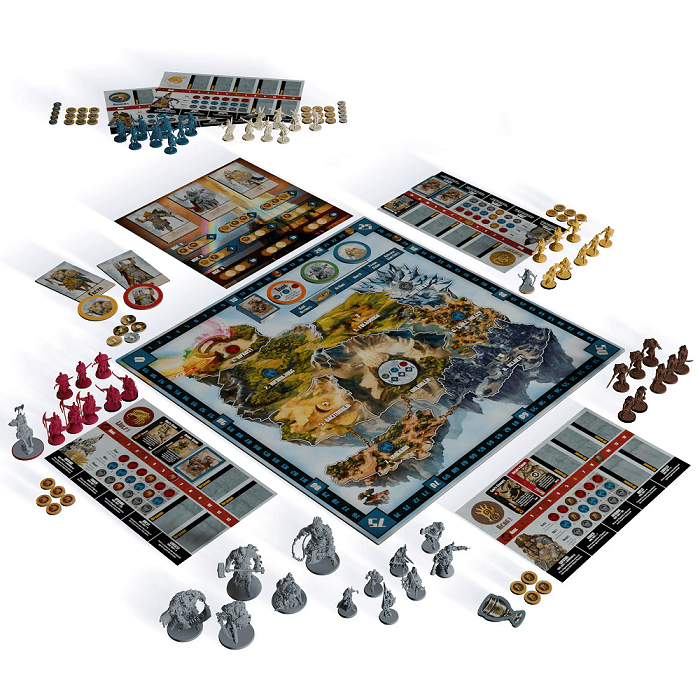
If you include the additional three options from the Road to Helheim expansion, there are eight total gods available. Eight sets of cards exploring various powers and subtleties in the design. Even swapping out just one of the gods creates a cascading effect of new fusions and novel combinations. Synergies emerge and my current impression is that one will have a much harder time falling into a rut of unassailable heuristics to stand upon. There are also many more monsters at the ready. Road to Hellheim beefs this number up quite a bit, showcasing the benefit of the expansion in a new dimension. The base game alone, however, is quite healthy.
There are some second order effects that fall out of the card system. One early criticism of Valhalla is that it embraces chaos in a way the original never did. Steelmanning this argument consists of recognizing that the revolving content results in a greater degree of unpredictability. If you only play this occasionally, this volatility may be the typical experience.
This is the wrong way to view this framework. If you are the type of player that wants to become intimately familiar with the cards in order to develop long-term strategies of play and counterplay, then stick with the same three gods for an extended time. At some point when you are ready, perhaps years down the line, you will have new experiences at your disposal. Until then, you have Blood Rage II.
Look, many people viewed the ideal Blood Rage expansion as simply a whole new deck of cards. No new plastic or cardboard, just give us a whole new deck. I was sympathetic to this. While the costs in storage and resources are not identical, one could view Valhalla as essentially two and a half new decks of cards for Blood Rage. Furthermore, these decks can be deconstructed and combined in various ways to expound upon that offering. This, for better and for worse, is much more than what we asked for.
Another under-recognized benefit is that a group can tailor their god selection to preference. Don’t like the Loki abilities that steal rage and glory? Don’t play with Loki. You still have seven other gods to choose from. This allowance of player authored editorial control is empowering.
There’s one more advantage to this content modularity, perhaps the most significant boon in this design: it completely re-levels the playing field.
This is actually the story here. One enormous burden with the original title was that it split my group. Half of us infatuated with the design and intimately familiar, the other half only briefly exposed to it. That second group is not keen to play Blood Rage with people who have pillaged Midgard dozens of times. The design is not accommodating to mixed experience levels. I’d even call it brutal in this regard.
That problem is gone. Completely. This is partially due to the game being new and full of surprises for all, but also because the sheer number of gods means that it’s far less likely for players to absorb the card pool and master its schemes. This creates a foundation for introduction and an overall easing of the skill curve. It makes for an experience that is friendlier to the unfledged, and if one subscribes to the Highlander creed, likely serves as a better option than the OG.
This equalization is the quality that I was most looking forward to, and the outcome is exactly what I hoped for. That second half of my cohort – the ones with trepidation towards playing Blood Rage – they’re now feasting in the halls of Odin and hungry for more.
Well, some are hungry for more. The problem is that a portion of these vittles are rotten. In Nathan Fielder fashion, I’ve been holding something back.
Let’s just tear the wound open and let the ichor flow: this game is woefully underdeveloped. The latter stages of creation, the ones where the finer details are given attention, seem to have never occurred. Player mats have incorrect language. Large swathes of cards use cavalier wording that produces collisions impervious to adjudication. Keywords are utilized which are never defined. Text is hazy to a point it can be interpreted in several ways. Not even the most reasonable arbiters will come to consensus, and it’s nearly impossible to experience the game as Lang intended.
It really is that bad. This is truly the story of Valhalla.
Let me spit some gore. During conflict, players secretly select a battle card from hand and then everyone reveals simultaneously. If one card has the word IMMEDIATE, and another has the phrase UPON REVEAL, which triggers first? What if the immediate ability allows you to swap with an upon reveal card? Does the player stealing the card trigger it, or the person who revealed it originally? Nothing in the rulebook is even in the realm of addressing this issue.
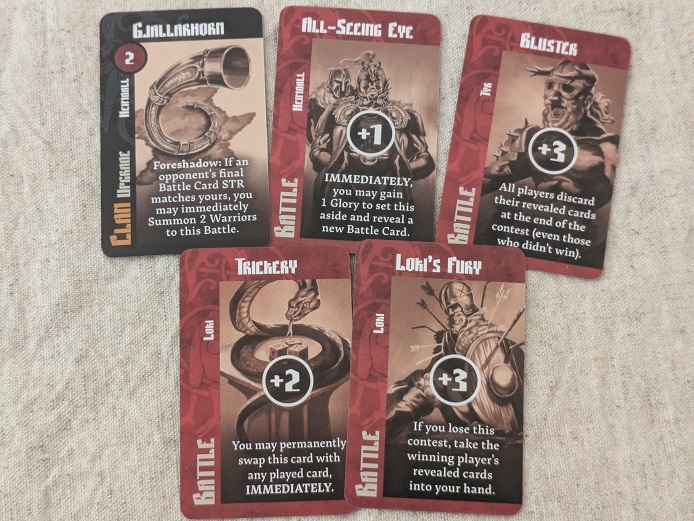
Problems such as this are myriad. Is a unit “killed” if it’s “removed”? What about a battle card “set aside” until the end of combat – does it fall under the umbrella of cards faceup and in play? You’re not allowed to summon into Valhalla, but what if an effect allows yout to summon a figure into the current contest? How about an ability that allows you to summon into ANY space?
The clang of battle rings louder in online discussion than it does within the halls of Odin.
One player in my group tapped out after a couple of sessions, refusing to play this game again until an extensive erratum is provided. This is a reasonable position to hold, as each of our encounters included lengthy debates over wording, derivation of Lang’s intent, and cross-referencing our opinions with those of the online community. And most of the time we came up empty handed and put it to a vote. I honestly can’t recall a game that was this susceptible to disagreement and confusion. What’s unnerving, however, is that this spurting wound likely can’t be properly cleaned. The ritual has already been performed, and a couple of stitches will not undo a blood eagle.
Imagine we get a sheet of clarifications. How is one to play this with a random group? Do you walk through all of the cards ahead of time? Do you spring rulings on them as effects enter play? They can’t ask questions mid-game as drafted cards are kept in secrecy. Even with experienced players, you may forget this information between outings making a game-altering misinterpretation likely. I don’t want to be antagonistic, but I’m stunned that none of the people who previewed this game even hinted at this degree of imprecision. I can’t imagine anyone playing and not running into trouble. I assure you, this is not hyperbolic.
Instead of ushering in the accolades and praise this design is worthy of, the release serves as a headstone to a grave of titles that deserved better.
I’m left in sheer dismay. I’ve never experienced something that oscillated so violently between the best game I’ve played and the most frustrating. How do you assess such a thing? What do you say when someone asks about it? How do I have any sort of real conclusion? I don’t know. Utter bafflement. I suppose this is the real story here.
A copy of the game was provided by the publisher for review.
If you enjoy what I’m doing and want to support my work, please consider dropping off a tip at my Ko-Fi or supporting me on Patreon. No revenue is collected from this site, and I refuse to serve advertisements.


Hey. Really appreciate this lengthy look. Like you, I’m a devotee of Blood Rage and Lang’s work, in general. But when I saw that a reboot was happening under the auspices of Tycoon, I had to pass because everything you cite in the game’s drawbacks seem to be symptoms of their lackadaisical approach. You’re absolutely right that the original suffers from a player experience problem, in that those with less experience are at a serious disadvantage to those who have more. If this version solves that, it’s as brilliant as you say. But you have to be able to play the game to make that assessment and with so many basic errors on cards, it sounds like you can’t really get there. I ran into the same thing when they bought out Gamelyn. The final production of TE Dungeons Adventures is replete with errors, dead ends in progression and basic problems that all of their playtesters and “game producers” cited before it was even sent into production. None of them were fixed and the game now has to be kit-bashed and house ruled to be played. I’m sorry it didn’t work out for you and your disappointment fairly shouts from the page. I’m still content to play my 10-year-old version (not least because I don’t really have room for a whole new one.) Thanks, again, for the detailed breakdown.
LikeLiked by 1 person
Thanks, Marc.
It is extremely frustrating. I think this game required a very experienced developer. A team of multiple people is listed in the rules booklet, but they clearly lacked the experience or knowledge to handle this complex of a game.
They are coming out with another game using these mechanisms called Rage of the Feathered Serpent. It seems like Eric Lang didn’t work on it at all, although I could be mistaken. I can’t see that crowdfunding campaign doing well.
LikeLike
Eric M Lang truly is the Orson Welles of game design in that he’s a genius but much of his catalogue is a story of thwarted opportunities and experiences that are hampered by being out of print or unfinished. There is no way I am agreeing to play this game until a physical errata pack is available.
LikeLiked by 1 person
The Orson Welles of game design is a hilarious comparison.
LikeLike