
Some people hear the pitch and they scrunch their face in skepticism. Others tilt their head and express curiosity.
I’ll hit ya.
A card is drawn and an object or thing is shouted out. “AN OWL! HOOT HOOT.”
You take a rope with a ball on it and then slide that ball down the strand until you’ve approximated the size of an owl. Think about it for a second. Make sure you’re happy.
After a moment of silence – usually broken with murmurs of confusion or angst – everyone reveals their twine and compares measurements. There’s usually some giggling or outright laughter at the results. The two players on the outliers, those who chose the shortest and longest sizes, lose. They forfeit a token and the game edges closer to conclusion.
But how the eff do you judge the size of an owl? Height or wingspan? Are we talking a barn owl? That Tootsie Roll dork? The white owl in Labyrinth?
That’s Size Wise, loser. You scrunching or tilting?
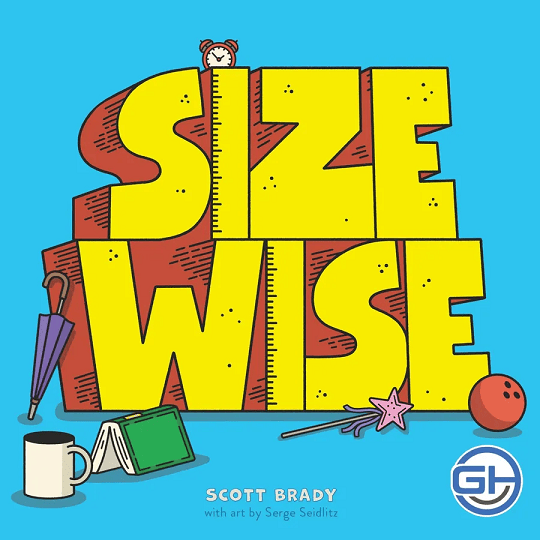
Size Wise tickles something in my soul. It’s not a rigorous game. It’s more of a cleanse for seriousness. The type of wacky activity that barely classifies as a game. Strangely, the best of these types seem to elicit the purest joy.
The concept is brilliant. I can certainly understand skepticism, but I’m all for unique designs, and Scott Brady’s little soiree is something different. This isn’t the 32nd version of Dominion, the 95th iteration of Apples to Apples, or yet another hobbying up of Yahtzee. You haven’t played this before.
Most people enjoy this without hesitation. Some reject the very spirit of the thing. This seems to happen most often with stringently logical thinkers. They struggle with this not actually being a game of accurately nailing measurements. It doesn’t matter how big a bratwurst is. It matters how big the group thinks a bratwurst is. Debate often erupts post-reveal.
“W-T-F. You all go vegan? The average bratwurst is five inches long.”
“What, are you a bratwurst specialist?“
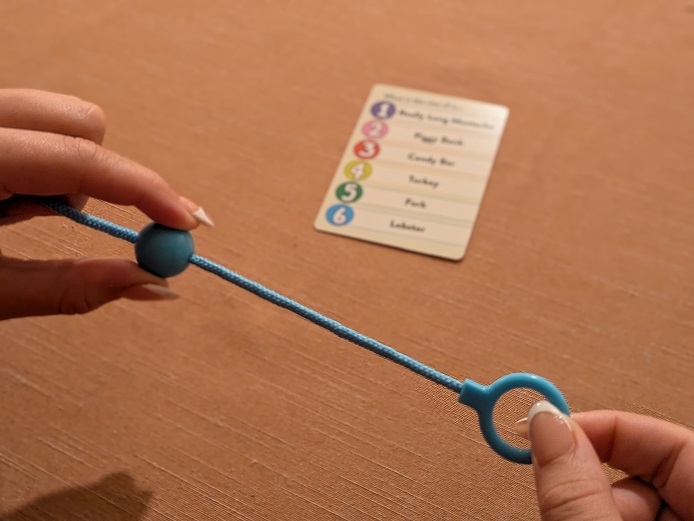
Size Wise does purport itself to be in a similar manner to games like Just One or Wavelength where you need to read the table and assume another player’s headspace. This is partially true. I have no idea what my closest friend thinks the size of a dog’s tail is. I can only settle on a fuzzy answer that I hope will be near the median. It’s not really about strategy or mind games. It’s more throwing a horseshoe and hoping you’re near the stake.
The cognitive action mostly settles around how to interpret the dimension to be measured. If the object is a laundry basket, are most people going to size it based on length? Width? Maybe even height? So, perhaps more accurately, you’re trying to assume the mentality of the aggregate and then position your ball in the median measurement of the selected dimension. If you’re not laughing and poking fun at the person who heard the word “flour” and set their rope to two inches, you’re not playing Size Wise.
Clearly, this game desires players that are willing to engage with this jovial ridiculing. Discussion doesn’t need to be mean, but Size Wise doesn’t bring the good stuff with a group of mutes. Being able to laugh at yourself is an asset in this experience.
Beyond a sporting attitude, there is an even more stringent limitation. I’m talking about player count. The box advertises 3-8. I get it, you want to present the minimum number in order to reach the widest audience. I guarantee you at least one person has requested a solo mode. But the problem is that this should not be played with three players. It’s dour and the impact is neutered. It shouldn’t be played with four either. I wouldn’t pull out Size Wise unless I had five, and I’d much rather have eight if I can manage it.
The experience is strictly improved with more people. The sizes tend to be more widely distributed with higher variance. Outliers are more likely to be extreme. Laughing is infectious and the whole discussion is more interesting. In my mind, Size Wise is a large group game.
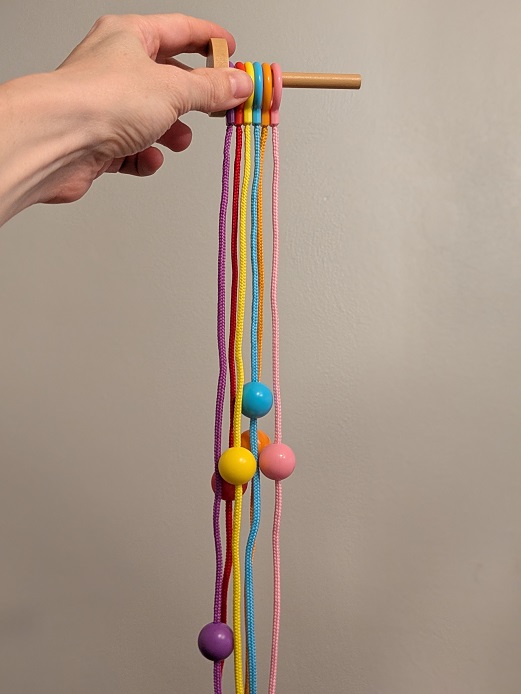
If you can assemble such a large group of free spirits – I’d recommend not calling them losers in the pitch – then this game will deliver exactly what it promises. It’s a very well put together title with the real heavy lifting being performed by the components. The product is designed so expertly that it’s easy to overlook while playing. The ropes are perfectly weighted and sized, the balls glide like magic while also not being too loose, and the wooden post used for comparing measurements is stellar. The functionality is incredibly smooth.
The only real criticism I have of this design is one all too common for its genre: the scoring is anemic. Many party games have this issue, and people often solve it by just ignoring points and playing until they decide to stop. The framework here isn’t terrible, it’s just not ideal.
When you’re one of the two measurements on the extreme, you discard one of your wisdom chits. As soon as a player runs out of these tokens the game ends. The winner is determined by whomever has the most remaining wisdom.
It’s fine. But it feels a little at odds with the central philosophy. Look, maybe my cohort are a bunch of pricks, but this game tends to spotlight those who fail. That’s where the humor and the best debate arise. I think the design would have been more unified with a Cockroach Poker style scoring approach. In this case, whoever runs out of wisdom first would be the loser and everyone else shares victory. Instead of trying to stay on top it becomes trying to avoid falling out the bottom. This may have been undesirable due to the way it focuses attention on the unfortunate which may result in anxiety or discouragement, but it would have been a more natural method. Of course, you can choose to play this way as a variant without problem.
This is such a minor criticism that it’s almost not worth making. But critiquing Size Wise is a much more difficult task than playing it. For those down with this goofy style of party game, there is just so much to appreciate within the small box. The components are excellent, the object list is sharp, and the experience is sufficiently novel in a world where that’s quite rare.
A copy of the game was provided by the publisher for review.
If you enjoy what I’m doing and want to support my work, please consider dropping off a tip at my Ko-Fi or supporting me on Patreon. No revenue is collected from this site, and I refuse to serve advertisements.

